By Richard Owen & Maurice FitzGerald
Field Notes on Customer AI · Edition 013 · July 28th, 2026
Each Tuesday, Field Notes surfaces what we're seeing in the field: patterns from implementations, ideas worth stress-testing, and the occasional inconvenient truth about how Customer AI programs succeed or stall. No abstractions. No product pitches. Just the working knowledge that tends to matter.
This edition covers something we feel quite strongly about, and that is NPS. We have both had roles in helping its adoption as the leading CX metric around the world. We always felt it was never a complete answer and we are now finally able to talk about what is both enhancing and replacing it.
If you like what you read today, please forward this to your colleagues and friends suggesting they learn more about customer retention and growth by subscribing here.
The Field Read
NPS was a measurement breakthrough, but... - Richard Owen
NPS was a measurement breakthrough. It was never a management one. That distinction mattered less in 2003 than it does today. When the methodology was first published, the ambition was modest and honest: give executives a single loyalty number that correlated with growth and was easier to benchmark than the twelve-page satisfaction instruments it replaced. On that basis, the work succeeded. More than 20 years later, NPS is the most widely adopted customer metric in the world, and companies that use it well tend to grow faster than companies that don't.
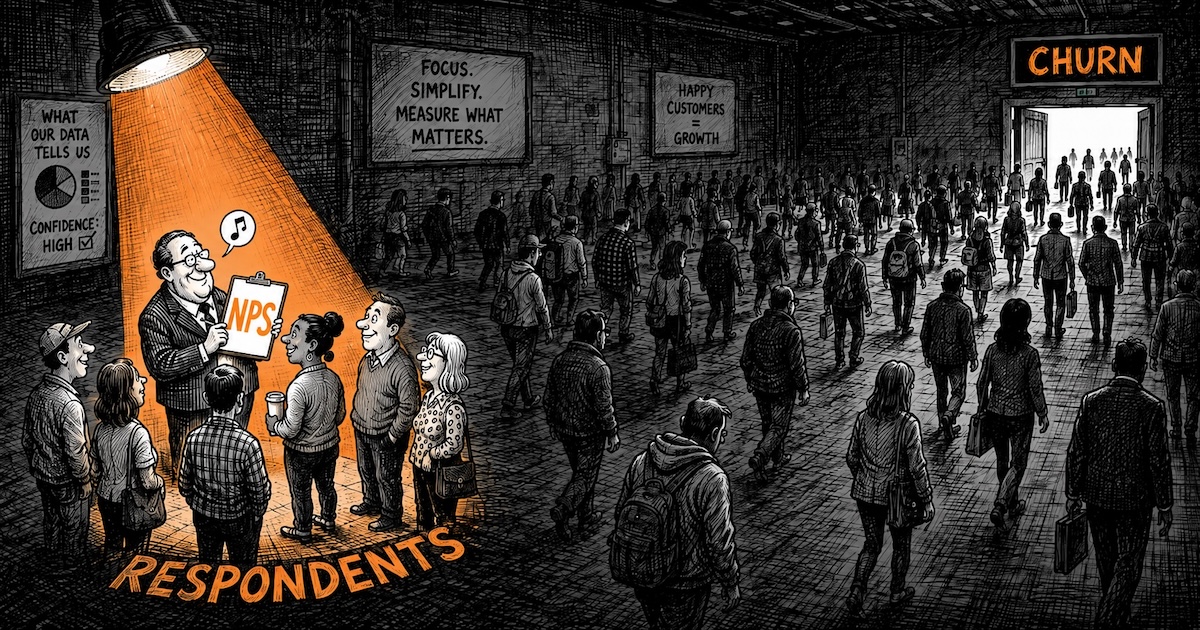
The problem is not the metric. The problem is the operating model built around it. Consider the economics: when the marginal cost of sending a survey falls to zero, customer attention becomes a commons, and like every commons, it gets overgrazed. Response rates on B2B surveys now routinely sit under ten percent. Of the ninety percent who don't reply, the CX program knows almost nothing. It sees the customers who raised their hand. It does not see the ones walking out the door.
A measurement system that describes only the vocal minority, reports in arrears, and hands executives a dashboard they are not expected to act on is not a management system. It is organizational theater with better graphics. This is not an argument against NPS. It is an argument for what comes next. The relevant question is no longer "What is our score this quarter?" It is "What do we know about every customer, right now, that lets us act before they decide to leave?" That is a different question, and it requires a different class of machinery to answer.
You weren't wrong to build customer experience measurement on the last system. You would be wrong to keep building on it.
The Practitioner's Take
Richard is right - Maurice FitzGerald
Richard is right, and I want to tell you what his argument looks like from inside a real company. Some years ago at HP, I presented a quarterly NPS review to a regional leadership team. The slides were good. The trend was positive. The room was polite. Afterwards one of the SVPs walked me back to my office and said, quietly, "Maurice, nobody in there is going to change what they do on Monday because of that number."
He was not being unkind. He was being honest. The CX team had measured. The rest of the business had listened and moved on.
At enterprise scale, this is the pattern. The customers who complain are often noisy and low-margin. The customers who quietly stop buying never filled in a survey at all. A program that sees only the vocal tenth of your base is not a program your CFO will fund forever, and it should not be.
So therefore: stop defending your response rate. Start asking a harder question. How would you manage every customer tomorrow if you already knew what they thought? The honest answer is that you would run the company very differently. That is the gap worth closing.
The Field Tactic
Three moves this week
Three things to do this week if what we are saying above resonates:
1. Size your blind spot. Pull last quarter's NPS response rate and multiply the non-respondent share by your average customer revenue. That number is the portion of your book the current program cannot see. Show it to your CFO. The conversation that follows tends to be useful.
2. Trace one silent loss. Pick an enterprise account that churned in the last twelve months. Count the surveys they completed in the year before leaving. For most, the answer is zero or one. Silent attrition is the pattern. The story of one specific account is often how leadership teams finally see it.
3. Run one predictive test. Take one hundred accounts with no recent survey response. Score them against behavioral signals: usage, support tickets, invoice disputes, leadership changes. Compare that list against renewals ninety days later. The hit rate will make the case better than any deck.
The Data Point
The number:
16%
That is the share of CX leaders who say their own programs uncover root cause, according to McKinsey research cited in The Customer AI Field Guide. A smaller share believe their program enables real-time action.
Read that again. Six out of seven CX professionals, describing the programs they personally run, do not believe those programs get to the "why" or drive action in the moment.
A measurement system whose own operators do not trust it to be actionable is, by definition, a system overdue for replacement. The number is not a criticism of the people. It is a verdict on the model.
The Iconoclast Question
This week's provocation
If your company stopped running customer surveys tomorrow, how long would it take anyone outside the CX team to notice? And if the honest answer is "a while," what has the program been for? Hit reply.
The Field Bridge
The Customer AI Masterclass is the certification program Richard built for CX, CS, and RevOps leaders who need to move from survey-dependent reporting to predictive account intelligence. Eight units. Self-paced. Built for practitioners, not data scientists.
[ Explore the Customer AI Masterclass →]
Coming in Future Editions
- The Guardrail is the Problem
- The Executive Sponsorship issue.

If you've been reading Field Notes, you know the problem isn't awareness - it's execution. Knowing that AI can improve retention or accelerate revenue doesn't tell you how to make it happen in your organisation. That's exactly the gap The Customer AI Field Guide was written to close. Authored by Richard Owen and Maurice FitzGerald (that's us), it's a practical execution guide for CX, CS, and RevOps leaders, covering how to identify at-risk accounts before they signal churn, convert customer insights into frontline action, build the financial case that gets CFO sign-off, and design Customer AI systems your teams will actually adopt. Theory optional. Results required.
[ Get the Customer AI Field Guide → Now on Amazon]
Field Notes publishes every Tuesday. Each edition focuses on one topic - a trap, a framework, a field observation, or a pattern worth examining. If something in here resonates, or if you're seeing something different in your own programs, we'd like to hear about it.

Responses