
By Richard Owen & Maurice FitzGerald
Field Notes on Customer AI · Edition 018 · September 1st, 2026
Each Tuesday, Field Notes on Customer AI surfaces what we're seeing in the field: patterns from implementations, ideas worth stress-testing, and the occasional inconvenient truth about how Customer Revenue Prediction programs succeed or stall. No abstractions. No product pitches. Just the working knowledge that tends to matter.
This edition is the first in a series that we are calling "The Great Sorting." It's about the end of the traditional models of CX and Customer Succcess strategies and measurements, and what replaces them. And we have to include a major example wherein capital markets believing in the current situation cost them $5.1 billion.
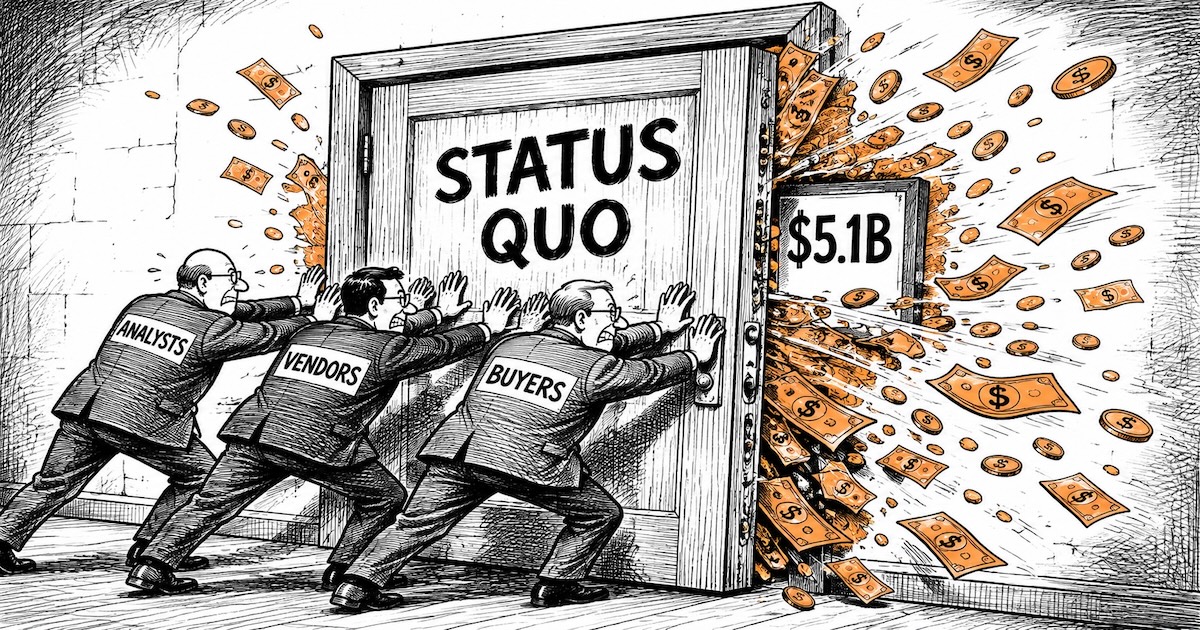
(Image generated using DALL-E)
If you like what you read, please forward this to your colleagues and friends suggesting they learn more about customer retention and growth by subscribing here.
The Field Read
The Great Sorting - Richard Owen
The traditional model of customer measurement and customer success is dying. It is dying for two reasons that compound each other: it never worked as advertised, and AI is not an upgrade to it but a replacement for it.
The survey process has been failing for two decades. Response rates across every survey-dependent institution have been in structural decline since the 1990s. Especially in B2B, the customers who still respond are unrepresentative of the customers who matter, and the customers considering leaving are the ones who have stopped talking to you. On this thinning substrate the industry built accountability structures of remarkable confidence: individual entity rankings, compensation schemes, executive dashboards, all calibrated against a signal from a shrinking fraction of the base. The causal chain from score to financial outcome was asserted far more often than demonstrated.
The capital markets noticed before the industry did. Thoma Bravo lost roughly $5.1 billion on Medallia before handing the company to its creditors. Momentive sold for a third of its agreed 2021 price. Qualtrics is parked at a flat-or-lower exit. The vendors describe this as transformation. Their new owners describe it, in documents with numbers in them, as workout.
Three groups are holding the door shut: analyst firms that certify the model their subscribers fund, incumbent vendors that just give new names to things because relabeling is cheaper than rebuilding, and buyers who cooperate because the renewal requires no memo, no sponsor, and no courage. Not deciding is deciding. The default ate the intent.
Read the full article: "The Great Sorting" → Here
The Field Dispatch
The Channel Problem – by Richard Owen
State Farm's CEO flew 19,000 agents to Las Vegas, treated them to a Pink concert, and told them he was ripping up their contracts. Their new contracts end deferred compensation, cut health benefits, and restructure commissions. The agents' anger is rational. The question is whether AI is driving the restructuring or providing cover for something that needed to happen anyway.
The honest answer is probably both. Progressive sells more than half its personal auto policies direct, using technology to keep acquisition costs low. State Farm carries the most expensive distribution model in the industry and has been pricing below market to absorb the cost. That position has a shelf life. The agents are the dealers, and the structural pressure is the same dynamic that made Dell's direct model eventually overwhelming for Compaq and HP in the 1990s. Those were not slow companies run by incurious people. They could not respond fast enough because their revenue depended on the channel they needed to disrupt.
Whether State Farm is doing the brave thing or the reckless thing is an honest question with no confident answer yet. What we can say is that any business model built around human intermediaries will feel some version of this pressure over the next decade.
Read the full article: "The Channel Problem" → Here
The Practitioner's Take
The Sorting I Watched From the Inside – by Maurice FitzGerald
I was at Compaq when Dell was rewriting the rules. Richard's description of the channel problem is not abstract history to me. I watched it happen from a desk inside the company that could not respond.
Everyone at Compaq understood the direct model. The economics were obvious. The problem was that acting on them meant attacking the revenue we had today for the promise of revenue we might have tomorrow. The dealers were real. The customers buying through those dealers were real. The direct model was a spreadsheet with assumptions.
Years later at HP Software, I ran customer experience programs that produced reports like the ones Richard describes in his Great Sorting article. Well-formatted. Well-received. Acted on by nobody. The quarterly review was mainly just a ceremony.
The thread connecting both of Richard's artilcles this week is the same organisational reflex. When the cost of acting is visible and the cost of staying is invisible, staying wins every time. Not because anyone chose it; simply because nobody had to.
So therefore: find the last three vendor renewals your team approved without a written evaluation. Those are the decisions that were made for you.
The Field Tactic
Three questions for the next renewal cycle
1. Audit the default. Pull every CX or analytics renewal from the past year that went through without a formal evaluation. Count them. That number is the size of your exposure to the sorting. If nobody wrote down why the renewal of your survey softwarwe contract was right, nobody decided it was. The absence of a memo is itself a finding.
2. Price the evaluation. For each default renewal, estimate what a proper assessment would cost in time and disruption. If it is less than five percent of the contract value, the reason you skipped it was not economics. It was organisational friction. Name the friction. It is almost always the discomfort of questioning a prior decision.
3. Write the missing memo. For one material renewal, draft the document nobody writes: "We evaluated alternatives and concluded the current vendor is the better option because [reasons]." If you cannot finish that sentence, you have your answer.
The Data Point
The 84-Year Reign
The number: 84
That is how many consecutive years State Farm held the position of largest personal auto insurer in the United States, from 1942 until Progressive took the title in 2026. Progressive sells more than half its policies direct to consumers, using technology to keep acquisition costs low. State Farm built its business on 19,000 exclusive agents. The technology-first model did not win because agents became unnecessary. It won because distribution cost is a variable that compounds. The sorting arrived in personal auto insurance with a date attached: May 2026.
Source: S&P Global Market Intelligence, May 2026.
The Iconoclast Question
The Renewal Test
Your organisation renewed its CX platform this year. Was there a memo? Was there a competing proposal? Was there a named decision-maker who signed off after comparing alternatives? If the answer to all three is no, you did not make a decision. You inherited one.

If you've been reading Field Notes, you know the problem isn't awareness - it's execution. Knowing that AI can improve retention or accelerate revenue doesn't tell you how to make it happen in your organisation. That's exactly the gap The Customer AI Field Guide was written to close. Authored by Richard Owen and Maurice FitzGerald (that's us), it's a practical execution guide for CX, CS, and RevOps leaders, covering how to identify at-risk accounts before they signal churn, convert customer insights into frontline action, build the financial case that gets CFO sign-off, and design Customer AI systems your teams will actually adopt. Theory optional. Results required.
[ Get the Customer AI Field Guide → Now on Amazon]
Field Notes publishes every Tuesday. Each edition focuses on one topic - a trap, a framework, a field observation, or a pattern worth examining. If something in here resonates, or if you're seeing something different in your own programs, we'd like to hear about it.

Responses