By Richard Owen & Maurice FitzGerald
Field Notes on Customer AI · Edition 022 · September 29th, 2026
Each Tuesday, Field Notes on Customer AI surfaces what we're seeing in the field: patterns from implementations, ideas worth stress-testing, and the occasional inconvenient truth about how Customer Revenue Prediction programs succeed or stall. No abstractions. No product pitches. Just the working knowledge that tends to matter.
This edition is the fourth in a series that we are calling "The Great Sorting." It's about the end of the traditional models of CX and Customer Succcess strategies and measurements, and what replaces them.
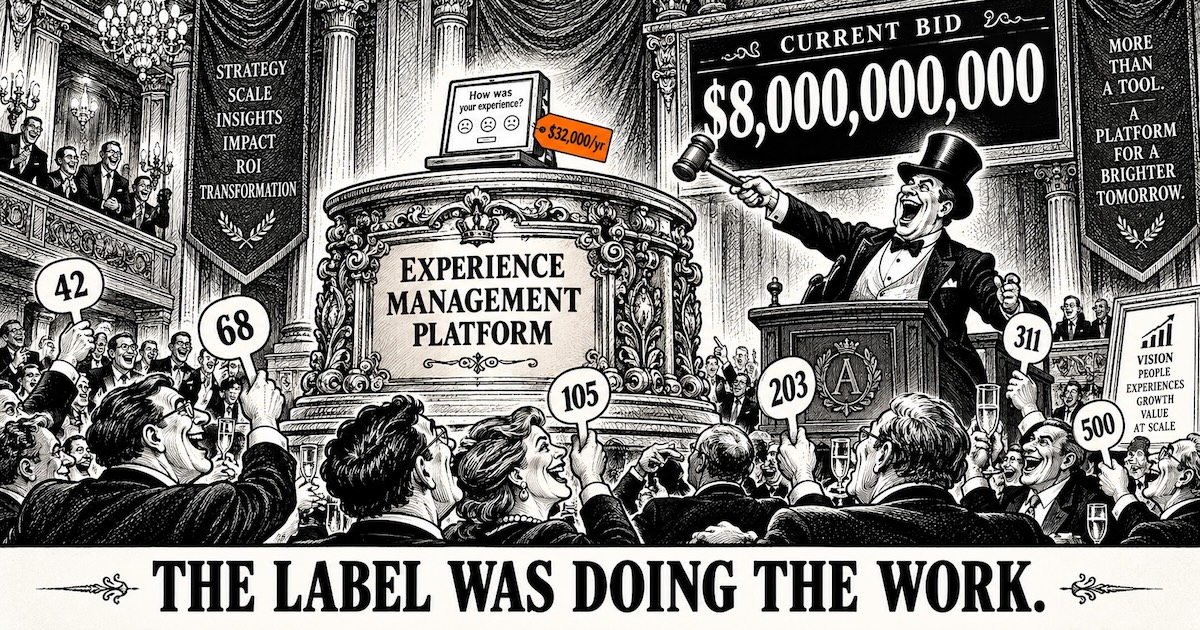
(Image generated using DALL-E)
If you like what you read, please forward this to your colleagues and friends suggesting they learn more about customer retention and growth by subscribing here.
The Field Read
SAP Paid Twenty Times Revenue for a $32,000 Product - by Richard Owen
In November 2018, SAP paid eight billion dollars for Qualtrics, four days before its IPO, at close to twenty times revenue. Four and a half years later it sold at roughly eight times. In between, Qualtrics tripled its revenue from $401.9 million to $1.46 billion and SAP said so in the press release. The revenue tripled and the value did not.
The market did not need four years to reach a view. Within days it had taken more than five percent out of SAP's capitalisation, close to $6.5 billion against an $8 billion price. The median enterprise SaaS multiple in that listing class was around seven. SAP paid twenty. It was not buying a growth rate.
What it was buying was a product with an average contract value of roughly $32,000 and a six-month sales cycle. SAP's plan was to hand that product to fifteen thousand people whose job was selling seven-figure ERP. A salesforce is not a distribution channel for any product that happens to be nearby. It is a distribution channel for the products it was built to sell. SAP never published a revenue synergy target for this deal. Not in the announcement, not in any filing.
The exit statement praised Qualtrics for tripling revenue on its own. There was no mention of experience management as a strategy, no cross-sell achievement of any kind. A category was declared at twenty times revenue. The product underneath it was thirty-two thousand dollars a year.
Read the full article: "SAP Paid Twenty Times Revenue for a $32,000 Product" → Here
The Field Dispatch
Bain Found the Hidden Buyer, Then Surveyed the Visible One – by Richard Owen
In June, Bain and LinkedIn published a new B2B metric called Likelihood to Buy, built on a survey of 750 people and recommended for use in commercial due diligence. The idea underneath it is correct: the decisive stakeholders in enterprise purchases are fiduciaries who can kill a deal without appearing in the CRM. A 2024 study by the same team found more than twenty people shaping a typical enterprise decision, and a close rate of 4 percent when only the recommending function knew the brand against 81 percent when the whole buying group did.
Having established that the decisive buyers are the ones you never hear from, the method proceeds to hear from whoever answers. A panel is a population of people who have agreed to answer surveys. Finding the hidden buyer only among people who answer questionnaires selects on the variable of interest.
The brief does not separate first purchases from repeat purchases. An incumbent is on the opening shortlist as a matter of course. Nobody assembles a shortlist for their payroll system and leaves off the vendor currently running payroll. If the sample mixes the two, a substantial share of the reported relationship between shortlist inclusion and win rate is incumbency appearing on both sides. The correlation holds. The chart looks convincing. The causal story about perception is doing far less work than it appears to.
Read the full article: "Bain Found the Hidden Buyer, Then Surveyed the Visible One" → Here
The Practitioner's Take
The Label on the Product – by Maurice FitzGerald
At HP Software we signed the renewal for our customer experience platform every year. The vendor called it an experience management system. What it actually was, stripped of the label, was a survey tool with a dashboard. The contract value was rather more than the thirty-two thousand dollars Richard describes.
I never wrote a memo about it. Nobody asked for one. The label on the product matched the label on my function, and that was enough to make the renewal feel like maintenance rather than a decision.
The response rates were declining every year. I reported the numbers without questioning whether a consumer survey instrument belonged inside an enterprise account base where the respondents were systematically unrepresentative of the customers who mattered. Richard's SAP article shows what happens when a product carries a category price and the category story stops. His Bain article shows what happens when a measurement method designed for one market gets bolted onto another. The same pattern at both scales. A label doing the work that evidence should be doing.
So therefore: remove the category label from your CX platform contract. Describe what the product does in one sentence. If that sentence contains the word "survey," you have a departmental tool at a platform price.
The Field Tactic
Three ways to test whether the label matches the product
1. Run the label test. Take your CX platform contract and write one sentence describing what the product does, not what the vendor calls it. If the sentence is "distributes a survey, collects responses, and displays them on a dashboard," you are paying a platform price for a departmental tool. The arithmetic that caught SAP at twenty times revenue catches buyers at every scale.
2. Map the buying group you cannot see. Take your last three closed-won deals and list every person who touched the decision. If your CRM knows fewer than half of them, your pipeline coverage is measuring the visible buyer and missing the one who can kill the deal without ever appearing in a forecast.
3. Split first purchases from renewals. Your win rate blends new logos with expansions. Separate them. If your close rate on first purchases is materially lower than on expansions tied to contract renewals, your commercial metrics are reporting incumbency as preference. That distinction changes where you spend.
The Data Point
The Buyer You Never Heard From
The number: 4%
That is the close rate when only the recommending function inside a buying group knew the vendor's brand. When the entire buying group knew it, including the hidden buyers in procurement, finance, legal and IT security, the rate was 81 percent. The study covered 515 large companies and found more than twenty people shaping a typical enterprise purchase. The decisive stakeholders are the ones most vendors never hear from. The methodology Bain then chose to measure them was a survey of people who had agreed to answer surveys.
Source: LinkedIn B2B Institute, Bain & Company, and NewtonX, enterprise buying group study, July 2024.
The Iconoclast Question
The Label Test
Your vendor calls its product a platform. Your budget calls it strategic. Remove both words and describe what it does in one sentence. If the sentence contains "survey," you have a thirty-two-thousand-dollar product at a platform price. What would you pay without the label?

If you've been reading Field Notes, you know the problem isn't awareness - it's execution. Knowing that AI can improve retention or accelerate revenue doesn't tell you how to make it happen in your organisation. That's exactly the gap The Customer AI Field Guide was written to close. Authored by Richard Owen and Maurice FitzGerald (that's us), it's a practical execution guide for CX, CS, and RevOps leaders, covering how to identify at-risk accounts before they signal churn, convert customer insights into frontline action, build the financial case that gets CFO sign-off, and design Customer AI systems your teams will actually adopt. Theory optional. Results required.
[ Get the Customer AI Field Guide → Now on Amazon]
Field Notes publishes every Tuesday. Each edition focuses on one topic - a trap, a framework, a field observation, or a pattern worth examining. If something in here resonates, or if you're seeing something different in your own programs, we'd like to hear about it.

Responses