By Richard Owen & Maurice FitzGerald
Field Notes on Customer AI · Edition 021 · September 22nd, 2026
Each Tuesday, Field Notes on Customer AI surfaces what we're seeing in the field: patterns from implementations, ideas worth stress-testing, and the occasional inconvenient truth about how Customer Revenue Prediction programs succeed or stall. No abstractions. No product pitches. Just the working knowledge that tends to matter.
This edition is the fourth in a series that we are calling "The Great Sorting." It's about the end of the traditional models of CX and Customer Succcess strategies and measurements, and what replaces them.
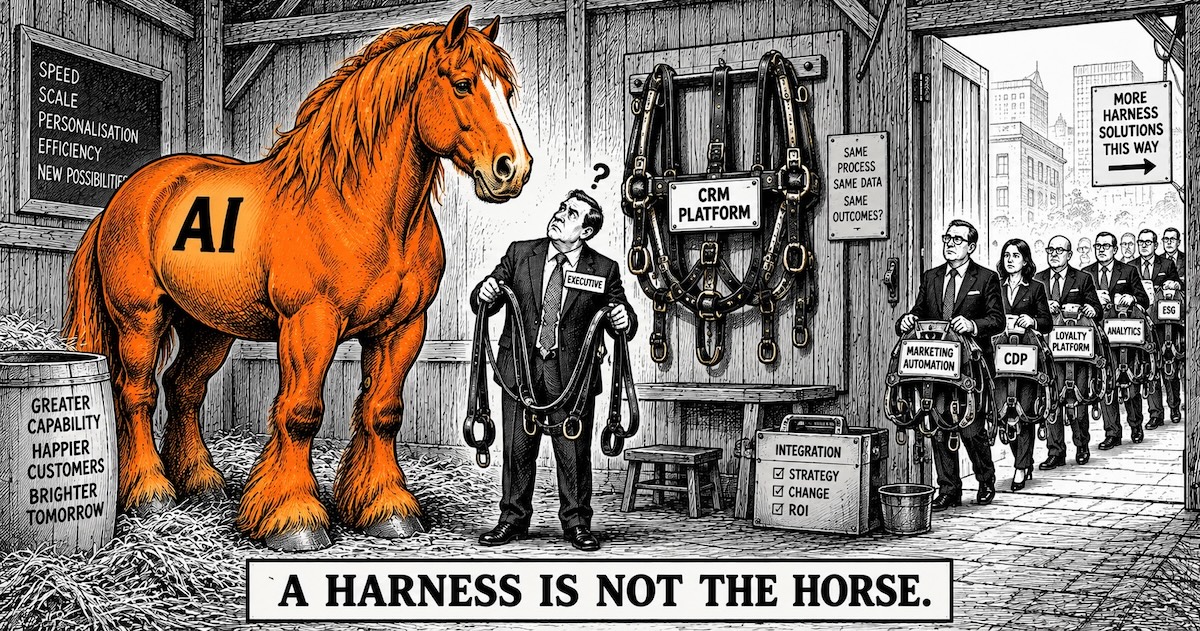
(Image generated using DALL-E)
If you like what you read, please forward this to your colleagues and friends suggesting they learn more about customer retention and growth by subscribing here.
The Field Read
The Harness and the Horse - by Richard Owen
Salesforce disclosed two things in its August quarter that belong in the same sentence. Data 360 ingested 104 trillion records in three months; eighty-two trillion arrived by zero copy, never moved into Salesforce at all. On the same day, Salesforce and Anthropic announced Claudeforce: sellers now work with live Salesforce records from inside Claude through a plugin with 37 prebuilt sales skills. Marc Benioff has a word for what Salesforce has become. He calls it a harness.
A harness is what you strap onto something else's power. It is not the horse.
The chronology makes the strategy legible. In March, co-founder Parker Harris asked, "Why should you ever log into Salesforce again?" In April, Headless 360 exposed the platform as APIs and MCP tools so that agents could operate it without a user interface. In August, Claudeforce completed the circuit. Salesforce is not storing the data and it is not doing the reasoning. It is holding the permissions, the schema and the business logic in between.
This was the right decision. Einstein was a bet that a CRM vendor could fund frontier-scale AI off CRM margins. By 2024 that was a bet against companies raising tens of billions for the single purpose of winning that fight. Salesforce stopped paying and bought equity in the winner instead. Of its $4.29 in GAAP earnings per share last quarter, $2.43 came from gains on its Anthropic stake. The most profitable thing Salesforce did was own a piece of someone else's horse.
Read the full article: "The Harness and the Horse" → Here
The Field Dispatch
The Crossroads Memo – by Richard Owen
The hardest thing this transition asks of you has nothing to do with data architecture. It is that you will have to contradict decisions with your own signature on them: the platform you chose, the team design you argued for, the metric targets you accepted.
The reframe that matters: you are not confessing an error. You are demonstrating calibration. The old model was right for an era of scarce data and expensive analysis. That era ended. The executives we remember are not the ones who never reversed. They are the ones who reversed well.
There are two doors, and you are standing between them. Door one is continuation: the survey programme, the renewals process, the health scores. Nothing about it requires a decision, which is its entire appeal. It fails on someone else's schedule, when the new CFO models your function's cost against its provable revenue effect, and twenty years use of a single methodology will not read as experience. It will read as exposure.
Door two costs something today. It means moving the centre of your function from opinion to behaviour, and telling your CFO that some of what you have reported sat on a sample too thin to carry the weight. The industry, as the capital markets have been explaining at ten-figure expense, is not coming to save you.
Read the full article: "The Crossroads Memo" → Here
The Practitioner's Take
The Layer You Thought You Owned – by Maurice FitzGerald
At HP Software I ran a customer experience function that owned the survey, the dashboard, and the quarterly review. I thought I owned the insight. What I actually owned was the harness Richard has described above.
The insight came from customers who chose to respond. The ones who mattered most had already stopped talking to us in many cases. I held the process and the permissions. The signal was somewhere else entirely, and I did not go looking for it because the process was generating reports and the reports were generating meetings and the meetings felt like successful work.
Richard's Salesforce example describes a platform that looked at what it owned and decided the interface was not the valuable part. His Crossroads Memo asks CX leaders to do the same inventory on their own functions. The platform retreated to what it could defend. The question is whether you can name what your function owns that would survive the same test.
I sat in that crossroads for longer than I should have. The numbers arrived on time. The decisions they were supposed to drive did not.
So therefore: list what your function owns. Ask whether each item survives when the interface disappears. The ones that do not are the ones you are about to lose.
The Field Tactic
Three Ways to Test What Your Function Owns Beneath the Interface
1. Run the harness audit. List everything your function produces: the survey, the dashboard, the quarterly report, the escalation workflow. Remove the interface. Which of those survive when the data arrives by other means and the reasoning happens elsewhere? The survivors are the function's actual value.
2. Score your reversal readiness. Take one decision your function made in the past three years and write the case for reversing it. If you cannot write it without defensiveness, you have found the decision that owns you rather than the other way around.
3. Find one behavioural signal you are not using. Your company already has data that predicts customer outcomes without asking customers anything. It sits in product telemetry, billing patterns, support frequency. Identify one source your function has never touched and run one retention prediction against it. That exercise tells you whether door two is real.
The Data Point
The 95% Who Stayed Where They Were
The number: 5%
That is the proportion of Salesforce knowledge workers on Sales and Service Cloud who have upgraded to the premium editions that include headless access, Agentforce and the agentic capabilities Benioff described as the company's future. The premium editions carry a 60 to 80 percent price increase. Ninety-five percent have seen the new price and stayed where they are. The platform has decided what it is. Its users, by overwhelming majority, have not followed. That gap between what the platform knows and what the seats have done is the crossroads, visible in a single adoption number.
Source: Salesforce Q2 FY2027 Earnings Call, August 2026.
The Iconoclast Question
The Harness Test
Your platform is going headless. Your vendor has decided its interface is not the asset. Name the layer underneath that your function owns, the one that survives when the screen disappears. If you cannot name it in one sentence, you are the interface.

If you've been reading Field Notes, you know the problem isn't awareness - it's execution. Knowing that AI can improve retention or accelerate revenue doesn't tell you how to make it happen in your organisation. That's exactly the gap The Customer AI Field Guide was written to close. Authored by Richard Owen and Maurice FitzGerald (that's us), it's a practical execution guide for CX, CS, and RevOps leaders, covering how to identify at-risk accounts before they signal churn, convert customer insights into frontline action, build the financial case that gets CFO sign-off, and design Customer AI systems your teams will actually adopt. Theory optional. Results required.
[ Get the Customer AI Field Guide → Now on Amazon]
Field Notes publishes every Tuesday. Each edition focuses on one topic - a trap, a framework, a field observation, or a pattern worth examining. If something in here resonates, or if you're seeing something different in your own programs, we'd like to hear about it.

Responses