By Richard Owen & Maurice FitzGerald
Field Notes on Customer AI · Edition 019 · September 8th, 2026
Each Tuesday, Field Notes on Customer AI surfaces what we're seeing in the field: patterns from implementations, ideas worth stress-testing, and the occasional inconvenient truth about how Customer Revenue Prediction programs succeed or stall. No abstractions. No product pitches. Just the working knowledge that tends to matter.
This edition is the second in a series that we are calling "The Great Sorting." It's about the end of the traditional models of CX and Customer Succcess strategies and measurements, and what replaces them.
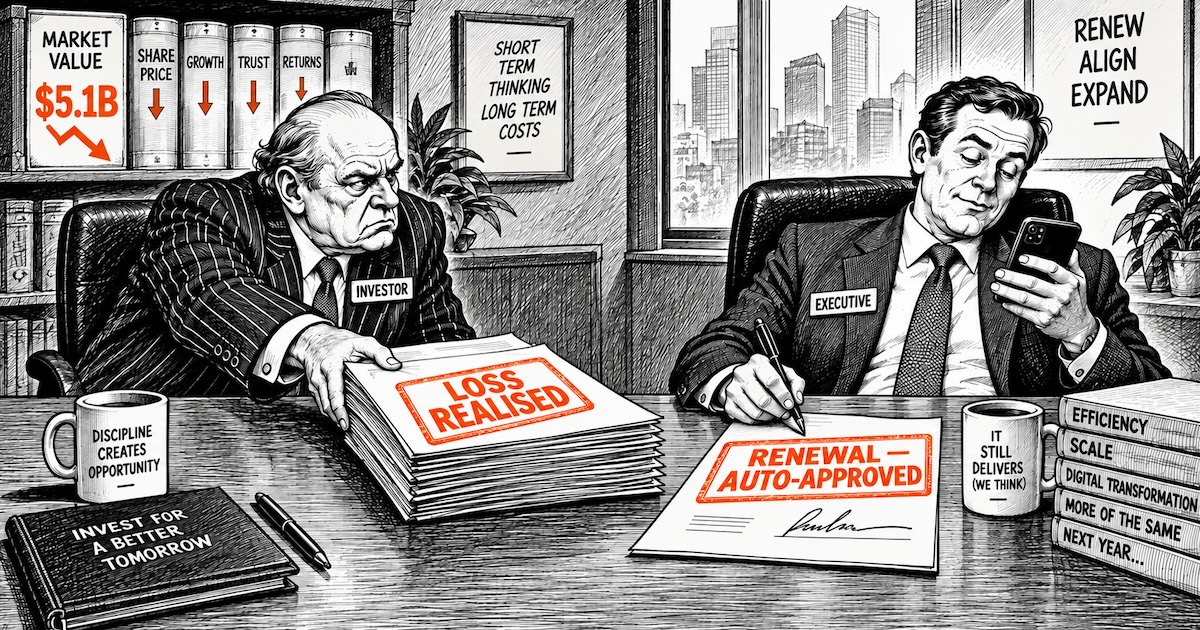
(Image generated using DALL-E)
If you like what you read, please forward this to your colleagues and friends suggesting they learn more about customer retention and growth by subscribing here.
The Field Read
The Great Sorting - Part 2 - Richard Owen
Last week was the premise. This week is the evidence, and it yields a conclusion the manifesto did not reach: every enterprise renewing one of these platforms this year is taking the other side of a trade against investors who preferred to realise their losses rather than hold.
The ledger runs four entries. Thoma Bravo lost $5.1 billion on Medallia before handing it to creditors led by Blackstone and Apollo. Momentive sold for a third of its agreed 2021 price. Qualtrics is parked at a flat-or-lower exit. Gainsight's founding assumption, that shortfalls in product execution are addressed by hiring a permanent remediation team, inverted when the price of money rose. Four proximate causes, four capital structures, one direction of travel. When causes appear to be independent of each other and outcomes are not, the causes you have decided upon are not the ones actually operating.
What all four were selling was flawed answers to one valuable question: which customers are about to leave, and what should you do about it? The survey model was designed around a collection method that cannot produce the evidence it promises. The headcount (meaning the customer success team) model survived on cheap capital. Both are now being repositioned as the same thing: the old architecture with AI wrapped around it. Neither becomes a system of intelligence that way, and calling AI the rescue is whistling past the graveyard.
The lenders who took the keys marked Medallia at roughly 61 cents. The professionals have set their prices. The operating world has not yet reacted appropriately.
Read the full article: "The Market Has Already Voted" → Here
The Field Dispatch
The Number They Are Quietly Walking Back – by Richard Owen
While the argument about whether AI makes customer software obsolete ran at conferences, several hyperscalers were quietly revising a number that determines whether the $2 trillion AI buildout is solvent or not: the useful life of a GPU.
On six-year depreciation, 2026 AI revenue clears the annual charge with roughly 19 percent of headroom. Shorten the assumption to three or four years and headroom goes negative. Lengthen it to eight or nine and the bears are wrong. The same two trillion dollars is, on one input, a catastrophe, a knife-edge, or a comfortably solvent industry.
AWS has revised the life of its servers four times in five years; effective January 2025 it cut a subset back from six years to five. Meta, on the same date, extended to five and a half years. Two of the largest operators revised the same financial estimate on the same day and disagreed about which way it should go. Neither called it a concession. Both priced it: Amazon paid $700 million; Meta collected $2.9 billion.
This reaches your desk as pressure rather than accounting, because the capex figures get quoted at you as vision, as inevitability, and as the reason your budget must move this year. Ask how many years they are assuming a GPU needs to return its investment. The answer tells you most of what you need to know about the rest of the pitch.
Read the full article: "The Number They Are Quietly Walking Back" → Here
The Practitioner's Take
The Number Nobody Re-examined – by Maurice FitzGerald
At HP, I presented customer satisfaction results every quarter. The number on the slide was always the score. Nobody ever asked about the denominator. What percentage of customers responded? Were the non-respondents different from the respondents in any way that mattered?
The answer to that second question was certainly yes. And nobody asked it, because the number on the slide looked precise. It moved in a direction. It had a comparison to last quarter. It behaved like a fact. It was an assumption dressed as one.
Richard's first article this week argues that every CX platform renewal is a trade taken against investors who have already marked their losses. His second argues that a two-trillion-dollar AI buildout rests on a depreciation assumption whose credible range separates solvency from insolvency. The pattern is identical. A number arrives looking solid. It gets inherited. The inheritance compounds until someone with money on the line re-examines it, and by then the distance between what was assumed and what was true has grown too wide to close gently.
So therefore: name one number in your customer program that has not been re-derived from first principles in the past two years. Declining survey response rates make NPS, CSAT, and indeed all other survey-based scores realistic candidates for you to consider. That is your depreciation schedule. Re-examine it before someone else does. You need a way to accurately future revenues from 100% of customers, and that is what Customer AI does.
The Field Tactic
Three inherited numbers worth re-examining this quarter
1. Your response rate trend. Not the current rate; the rate of change over three years. If the denominator of your customer measurement programme is declining and nobody has modelled where it intersects uselessness, you are managing to a signal with a known expiry date and no alarm set.
2. Your renewal ROI. Take the annual cost of your CX or CS platform and divide it by the attributable revenue decisions it influenced last year. Not "insights generated." Decisions made differently because the platform existed. If the number requires a story rather than a ledger entry, the number is not a number.
3. Your cost per insight versus cost per prediction. Survey-derived insight costs what the programme costs divided by the actions taken. A predictive model costs what the model costs divided by the interventions triggered. Run both calculations. The ratio tells you which side of the sorting you are building toward.
The Data Point
The abandonment curve
The number: 42%
That is the proportion of companies that abandoned most of their AI initiatives in 2025, up from 17 percent the year before, a 147 percent increase in a single year. The average organisation scrapped 46 percent of proof-of-concept projects before they reached production. When CX vendors promise that an AI wrapper will transform a survey platform into a system of intelligence, this is the base rate they are betting against. Not the success stories in the keynote. Not the pilot that impressed the steering committee. The median outcome in the field, measured across more than a thousand enterprises.
Source: S&P Global Market Intelligence, 2025 enterprise survey (1,000+ organisations, North America and Europe).
The Iconoclast Question
The Counterparty Test
Your CX platform vendor's previous investors chose to accept billions in losses rather than hold. You renewed. One of you has mispriced the asset. If you are confident it is them, write down why. If you cannot, you are not a contrarian. You are a bystander.

If you've been reading Field Notes, you know the problem isn't awareness - it's execution. Knowing that AI can improve retention or accelerate revenue doesn't tell you how to make it happen in your organisation. That's exactly the gap The Customer AI Field Guide was written to close. Authored by Richard Owen and Maurice FitzGerald (that's us), it's a practical execution guide for CX, CS, and RevOps leaders, covering how to identify at-risk accounts before they signal churn, convert customer insights into frontline action, build the financial case that gets CFO sign-off, and design Customer AI systems your teams will actually adopt. Theory optional. Results required.
[ Get the Customer AI Field Guide → Now on Amazon]
Field Notes publishes every Tuesday. Each edition focuses on one topic - a trap, a framework, a field observation, or a pattern worth examining. If something in here resonates, or if you're seeing something different in your own programs, we'd like to hear about it.

Responses