
By Richard Owen & Maurice FitzGerald
Field Notes on Customer AI · Edition 016 · August 18th, 2026
Each Tuesday, Field Notes on Customer AI surfaces what we're seeing in the field: patterns from implementations, ideas worth stress-testing, and the occasional inconvenient truth about how Customer Revenue Prediction programs succeed or stall. No abstractions. No product pitches. Just the working knowledge that tends to matter.
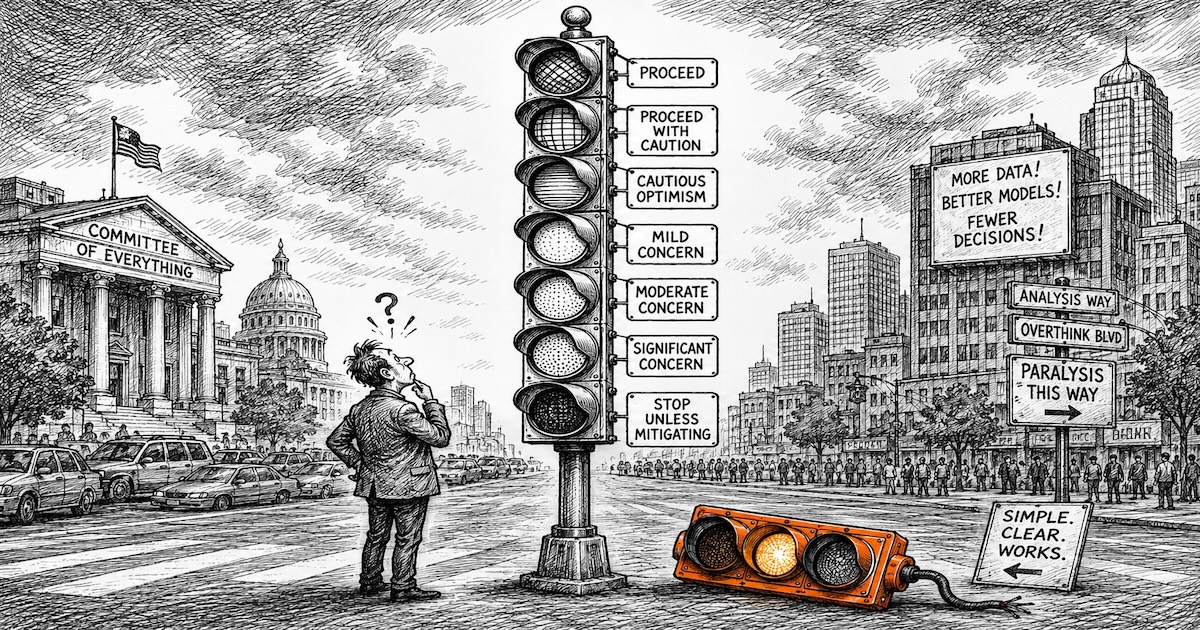
This time we are going way back to 1956. Yes, the George Miller article was published 47 years before The One Number You Need To Grow appeared in the Harvard Business Review. It's very relevant to NPS anyway, though we want to push you to go even further than Miller suggests, simply to limit confusion.
(Image generated using DALL-E)
If you like what you read, please forward this to your colleagues and friends suggesting they learn more about customer retention and growth by subscribing here.
The Field Read
George Miller Was Right About NPS - Richard Owen
George Miller published "The Magical Number Seven, Plus or Minus Two" in 1956. By a comfortable margin, it is the most cited paper in cognitive science that nobody applies in practice. Our brain's working memory holds approximately seven items. The channel capacity for absolute judgment, the number of categories across which humans make reliable distinctions, is roughly five to six. This is architecture, not a performance issue correctable with training or a more expensive dashboard.
The implication for measurement systems is direct. If a system's output must travel through a human decision-maker before it becomes action, the number of meaningful categories is bounded by the channel capacity of the person at the other end. The three-bucket collapse in NPS, Promoters, Passives, Detractors, is not an analytical concession to simplicity. It is calibration to the cognitive architecture of the executive who has to act on it.
The NPS backlash has spent a decade arguing the metric is too simple while proposing alternatives with more dimensions. This is a category error. It evaluates a decision signal by the standards of an analytical instrument. Nobody has ever slowed down at a "chartreuse, proceed with cautious optimism" light. The frameworks proposed as replacements are better analytical instruments and worse decision signals. Organisations that have invested most heavily in them have not produced better customer outcomes. They have produced reports. Very handsome reports. Reports that win internal awards. Reports that nobody acts on.
AI has made the problem dramatically more consequential. Synthesis is now cheap. The scarce resource is the decision rule that converts synthesis into a signal the executive can act on. Miller's constraint has not changed. The volume of synthesis flooding past it has. The answer is not more dimensions. It is better decision rules calibrated to a brain that still holds seven items, plus or minus two.
Read the full article: "George Miller Was Right About NPS" → Here.
The Practitioner's Take
The Strategy Course That Proved Miller Right – by Maurice FitzGerald
In 2005, I attended Columbia Business School's "Creating Breakthrough Strategy" course. The main lecturers were Willie Pietersen and Rita McGrath. The course changed how I thought about priorities for the rest of my career.
Willie made one argument I have never forgotten. The maximum number of strategic initiatives an organisation can pursue must be small enough to count on the fingers of one hand. Not because leaders lack ambition. Because employees cannot remember more than five priorities, and a priority nobody can recall is not a priority at all.
I had spent the previous decade in organisations where the strategic plan routinely contained twelve to fifteen initiatives. Every quarter we reviewed progress against all of them. Every quarter the same three received attention and the rest received slides. The organisation had not failed to execute. It had failed to choose. Twelve priorities is zero priorities with better formatting.
Willie was making Miller's argument in operational language. A decision signal that exceeds the cognitive capacity of the person receiving it does not produce a decision. It produces a deck.
So therefore: count your current strategic priorities. If the number exceeds what your team can recall without consulting a document, you have a list, not a strategy.
The Field Tactic
Three ways to design decision signals that respect cognitive limits
1. Collapse before you present. If your customer health score has more than five categories, the executive receiving it will simplify it anyway, using intuition or whatever heuristic is available, probably a bad one. Design the collapse deliberately. The best decision rule is one where the complexity happens upstream and the signal arrives within Miller's range, preferably at the low end.
2. Test recall, not comprehension. After your next quarterly business review, ask three attendees to name the top customer priorities from memory. If they cannot, the signal failed. Comprehension in the room is not the same as retention after the room. The test is what survives the walk back to the desk.
3. Separate the analytical layer from the decision layer. Let AI synthesise across every dimension it can. Then impose a bounded decision output at the top. The richest analysis in the world is useless if it never becomes a decision the executive can hold in working memory and act on.
The Data Point
The overoad tax
The number: 20%
That is the reduction in decision quality caused by information overload, according to a study published in the Journal of Behavioral Decision Making. (It seems optimistic to us.) More information past a cognitive threshold does not produce better decisions. It produces worse ones. Over 70% of executives cite managing information overload as their top challenge, according to McKinsey. Miller's channel capacity has not changed since 1956. The volume of information aimed at it has increased by orders of magnitude. The result is not better-informed executives. It is executives making twenty percent worse decisions with considerably more data.
Source: Journal of Behavioral Decision Making, 2023; McKinsey executive survey, 2022.
The Iconoclast Question
The recall test
Your last quarterly business review presented a customer framework with multiple dimensions, health scores, and analytical layers. Without looking at the slides, how many of those dimensions can you name right now? The number you can recall is the number that influenced your decisions. The rest was decoration.

If you've been reading Field Notes, you know the problem isn't awareness - it's execution. Knowing that AI can improve retention or accelerate revenue doesn't tell you how to make it happen in your organisation. That's exactly the gap The Customer AI Field Guide was written to close. Authored by Richard Owen and Maurice FitzGerald (that's us), it's a practical execution guide for CX, CS, and RevOps leaders, covering how to identify at-risk accounts before they signal churn, convert customer insights into frontline action, build the financial case that gets CFO sign-off, and design Customer AI systems your teams will actually adopt. Theory optional. Results required.
[ Get the Customer AI Field Guide → Now on Amazon]
Field Notes publishes every Tuesday. Each edition focuses on one topic - a trap, a framework, a field observation, or a pattern worth examining. If something in here resonates, or if you're seeing something different in your own programs, we'd like to hear about it.

Responses