By Richard Owen & Maurice FitzGerald
Field Notes on Customer AI · Edition 0167 · August 25th, 2026
Each Tuesday, Field Notes on Customer AI surfaces what we're seeing in the field: patterns from implementations, ideas worth stress-testing, and the occasional inconvenient truth about how Customer Revenue Prediction programs succeed or stall. No abstractions. No product pitches. Just the working knowledge that tends to matter.
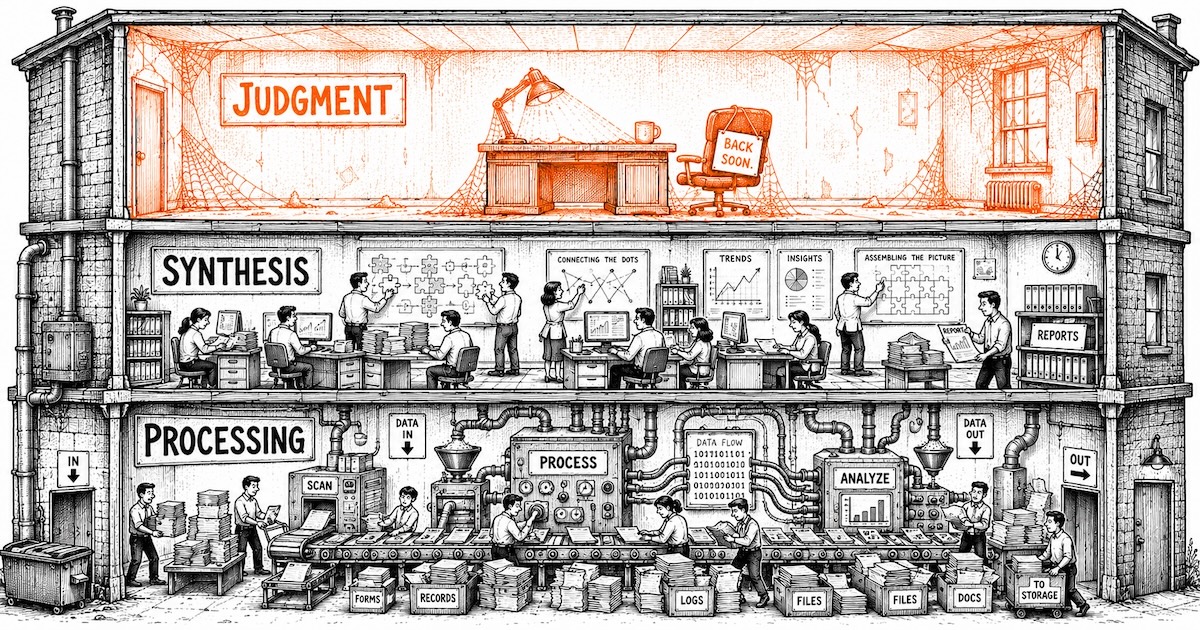
This time we examine exactly which types or 'layers' of work and of memory AI can replace and which it can't at least for the time being. Worth reading, at least in our somewhat biased opinions.
(Image generated using DALL-E)
If you like what you read, please forward this to your colleagues and friends suggesting they learn more about customer retention and growth by subscribing here.
The Field Read
The Central Executive - Richard Owen
Alan Baddeley's model of working memory identifies three functionally distinct layers. The first handles processing: reading information, retaining it, building on it. The second handles synthesis: combining inputs from multiple sources into a coherent picture. The third, which Baddeley named the Central Executive, does something categorically different. It sets priorities across competing demands, allocates attention, responds to situations without clear precedent, and makes the judgment about what matters and why.
The AI buying conversation has been concentrated in layers one and two for the last three years. Processing and synthesis are genuinely valuable, and the enterprise should be investing in them. What almost nobody is asking is whether the investment is preserving or degrading layer three. The current deployment wave treats the Central Executive as a residual: the judgment that happens after the technology has done its work. That framing is wrong. Layer three is the governing function that determines whether layers one and two are pointed at the right problems. Treating it as a residual is a governance failure dressed as a deployment strategy.
The cognitive market is democratising at the bottom. Layer one and layer two work is approaching commodity pricing. The advantage that remains is layer three judgment, and that cannot be bought.
Daron Acemoglu's concern, drawn on by Sami Mahroum in Project Syndicate, is not that AI will fail. It is that AI will succeed well enough to cause institutional atrophy. The firm that automates layers one and two and stops investing in the human capacity to supervise those outputs will arrive at a condition in which the AI runs the analysis and the organisation ratifies it. You did not decide to remove the judgment layer. You just stopped deciding not to. Once the people who know what good analysis looks like have gone, rebuilding layer-three capacity is slow, expensive, and not reliably possible.
Read the full article: "The Central Executive" → Here.
The Practitioner's Take
The Planning Fallacy and the Missing Executive – by Maurice FitzGerald
Daniel Kahneman and Amos Tversky identified what they called the planning fallacy: the systematic tendency to underestimate the time, cost, and risk of a project while overestimating its benefits. The pattern holds even when people have direct experience of similar projects failing. They know the history and they ignore it.
Kahneman's explanation is that people plan from the "inside view," building estimates from the specifics of the case in front of them. The "outside view," asking what happened when similar things were attempted before, requires a different cognitive function. Someone must step back from the analysis and challenge the assumptions. That function is Baddeley's central executive.
I have watched this across three decades of technology deployments. The business case is built on excellent data and comprehensive synthesis. The timeline is wrong. The resource estimate is optimistic. The risk assessment is incomplete. Nobody in the room is performing the function of applying the outside view to the inside plan.
So therefore: the next time an AI deployment team presents a business case, ask one question. What happened the last three times an organisation like yours attempted something of that scale? If nobody can answer, your Central Executive is missing.
The Field Tactic
Three ways to protect the central executive in an AI-automated organisation
1. Hire for judgment, not processing. The analyst who runs a model is not the analyst who can tell you whether the model captures the right thing. As AI handles layers one and two, the hiring profile shifts to judgment capacity. If your last three analytical hires were evaluated on technical skill rather than evaluative judgment, you are replacing layer three with more layer two.
2. Measure decisions, not dashboards. The relevant metric is not how many insights the system produced. It is whether the decisions were good. Track revenue retained, risks caught early, interventions that changed outcomes. If your AI investment report measures coverage and throughput, you are measuring the input, not the output.
3. Build the evaluation step. If AI synthesis triggers action directly without a human judgment step, you have automated away the Central Executive. Design workflows where AI outputs are inputs to a decision, not the decision itself. Yes, over time, some decisions can be automated, simply because they are highly predictable, but you should not start off that way.
The Data Point
The Judgment Migration
The number: 49%
That was the proportion of US occupations in which at least a quarter of tasks are now performed with AI assistance, according to Anthropic's March 2026 Economic Index. The number is probably much higher by now. The finding that matters is where the penetration is happening. AI is not concentrating at the execution base, processing and synthesis, the layers where most organisations expect it. It is spreading into the judgment layer. The organisations that assumed AI deployment was a layer one and layer two investment are discovering that layer three is being affected whether they planned for it or not.
Source: Anthropic Economic Index, March 2026.
The Iconoclast Question
The Residutal Question
Your organisation deployed AI to process more data and produce better synthesis. Who is evaluating whether the AI is pointed at the right problems? If the answer is "the same team, with fewer people," you have treated the Central Executive as a budget line, not a governance function.
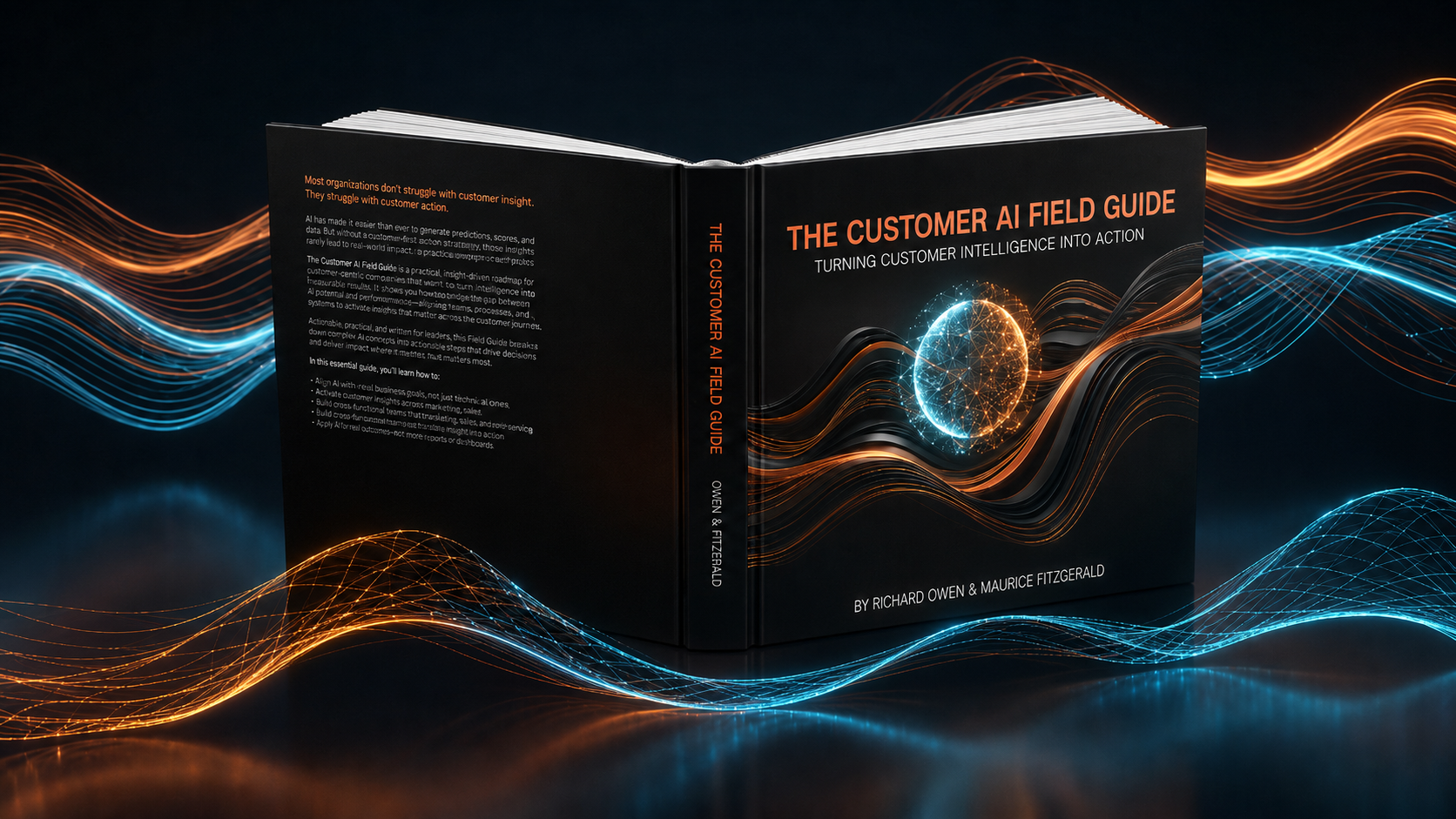
If you've been reading Field Notes, you know the problem isn't awareness - it's execution. Knowing that AI can improve retention or accelerate revenue doesn't tell you how to make it happen in your organisation. That's exactly the gap The Customer AI Field Guide was written to close. Authored by Richard Owen and Maurice FitzGerald (that's us), it's a practical execution guide for CX, CS, and RevOps leaders, covering how to identify at-risk accounts before they signal churn, convert customer insights into frontline action, build the financial case that gets CFO sign-off, and design Customer AI systems your teams will actually adopt. Theory optional. Results required.
[ Get the Customer AI Field Guide → Now on Amazon]
Field Notes publishes every Tuesday. Each edition focuses on one topic - a trap, a framework, a field observation, or a pattern worth examining. If something in here resonates, or if you're seeing something different in your own programs, we'd like to hear about it.

Responses