By Richard Owen & Maurice FitzGerald
Field Notes on Customer AI · Edition 009 · June 23, 2026
Each Tuesday, Field Notes surfaces what we're seeing in the field: patterns from implementations, ideas worth stress-testing, and the occasional inconvenient truth about how Customer AI programs succeed or stall. No abstractions. No product pitches. Just the working knowledge that tends to matter.
We are covering a topic that suprised us when we first saw it happening. Now it seems to be the rule rather than the exception. This is all about cultural resistance to using AI that already works well.
The Field Read
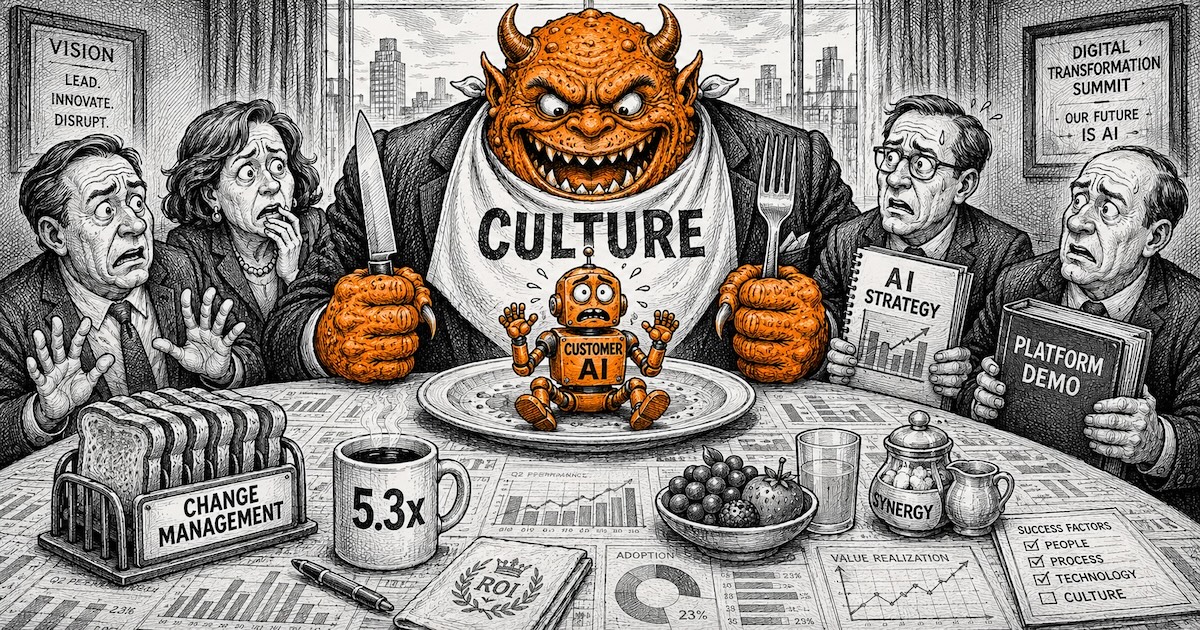
Why Culture Eats Customer AI for Breakfast - Richard Owen
Last month at The Economist's AI conference in London, I watched a room full of CFOs independently arrive at the same conclusion. The topic was AI. The setting was a technology conference. And yet every panel ended up in the same place: the problem is not the technology. It is the people.
BCG's research across 1,800 C-suite executives confirms that roughly seventy percent of challenges in AI projects stem from people and process issues, not technical ones. McKinsey sharpens the point: the executives who report creating real value from AI are three times more likely than their peers to say that senior leaders actively model its use. Where leadership is absent, adoption stalls regardless of what tools have been deployed. But here is where it gets properly interesting. BCG and Columbia Business School surveyed both executives and frontline workers, and the perception gap is the kind of thing you would find funny if it were not so expensive. Eighty percent of leaders believe their employees are well-informed about the company's AI strategy. Among individual contributors, that number is twenty-nine percent.
For Customer AI specifically, the barriers are compounded. Customer experience was constructed as a measurement discipline. NPS, CSAT, voice-of-customer programmes: these are not just tools, they are identity. Asking CX teams to become a predictive discipline, modelling behaviour across the entire customer base using operational and financial data, is not a tool upgrade. It is an identity shift. And identity shifts trigger every cultural barrier in the book, because the leaders who would need to commission the transformation are the same ones whose expertise it would render obsolete.
Organizations that invest in culture change alongside technology see 5.3 times higher success rates than technology-only approaches. Five point three times. The platform wins almost every time, because platforms have vendor demos and culture change has difficult conversations.
Read the full article: "Why Culture Eats Customer AI for Breakfast" → Here.
The Practitioner's Take
Yes, cultural traditions made me blind to AI too - Maurice FitzGerald
Shortly after HP CEO Meg Whitman pushed former Autonomy software CEO Mike Lynch out of the company back in 2012, I was appointed as the only HP person in the Autonomy leadership team. Autonomy was an early AI company and the IDOL software was amazing. I quickly discovered its ability to do what we now call Natural Language Processing. We even went through a brief period where we used it to scrape the web for the latest content about our largest accounts and automatically sent the resulting 'Autonomy Herald' newsletters to relevant account managers. They didn't use it.
We Autonomy VPs all attended a gathering of all HP VPs in Anaheim. All attendees filled in a survey about the event a few hours before it ended. I managed to get hold of all of the responses and the head of Autonomy R&D (Sean Blanchflower) rushed to another room and processed all of the answers to the open questions. The result of that analysis was summarized in three points. The HP staff member who had set up the survey analyzed the input by eyballing it. The extent of confirmation bias in her analysis was such that her top three points had nothing in common with the IDOL NLP result.
Strangely, in hindsight, it never even occurred to me to use the IDOL technology to summarize surveys, or indeed to analyze operational data to predict which customers were most likely to stay or leave when future contract renewal dates came up.
The technology was not the problem. It worked well. The problem was that nobody had changed my job. I was still measured on the same survey-based KPIs, still presenting the same quarterly dashboards, still rewarded for the same activities. I had been given a new tool and no new reason to use it. The old workflow was comfortable, familiar, and produced the performance reviews I needed. I saw the new platform was optional in practice. A great pity, given we could have had it on the market years before anyone else-
So therefore: before you deploy any Customer AI capability, answer one question first. Have you changed what your CX team is measured on? If the KPIs still reward survey collection and dashboard production, the new technology will sit beside the old workflow, unused. Measurement drives behaviour. Change the measurement first.
The Field Tactic
Three steps to make cultural change precede technology:
-
Run the perception audit. Survey your CX team anonymously on two questions: do you understand the company's Customer AI strategy, and do you feel equipped to execute it? Compare the results to what your leadership team believes. BCG found a fifty-one-point gap between executives and individual contributors. Your gap is worth knowing before you spend another dollar on technology.
-
Reassign one KPI. Take one metric your CX team is currently measured on, something retrospective like quarterly NPS movement, and replace it with a forward-looking indicator: accounts flagged for early intervention, or behavioural risk signals acted on within thirty days. One KPI change signals more than any training programme.
-
Make one leader go first. Identify one executive sponsor who will use Customer AI outputs in their next operating review, visibly and by name. McKinsey's data shows that leadership modelling is the single strongest predictor of adoption. One leader using the output publicly changes the permission structure for everyone else.
The Data Point
The number:
The 51-point reality gap
That is the gap between what leaders believe about AI readiness and what employees actually report, according to BCG and Columbia Business School. Eighty percent of executives believe their workforce is well-informed about the company's AI strategy. Twenty-nine percent of employees agree. This perception gap explained thirty-six percent of the variance in AI maturity across the organizations studied, more than industry, department, or company size.
The single most powerful predictor of whether your AI investment will pay off is whether your people feel heard and prepared. The people making the investment are confidently wrong about whether that is happening.
Source: BCG and Columbia Business School, 2025; cited in Richard Owen in 'Why Customer AI Eats Culture for Breakfast'.
The Iconoclast Question
The Identity Test
If Customer AI succeeds in your organisation, the CX team's job changes from measuring what customers felt to predicting what they will do. How many people on your current team would welcome that shift, and how many would quietly resist it?
The Field Bridge
The Customer AI Masterclass covers what changes in CX teams when predictive intelligence replaces retrospective measurement. Module 8 is where that subject starts.
[ To learn more → Click here]
Coming in Future Editions
- Enterprise AI Is Failing the Same Way Enterprise IT Always Did.
- Why NPS was never enough, and what replaces it.
- The Executive Sponsorship issue.
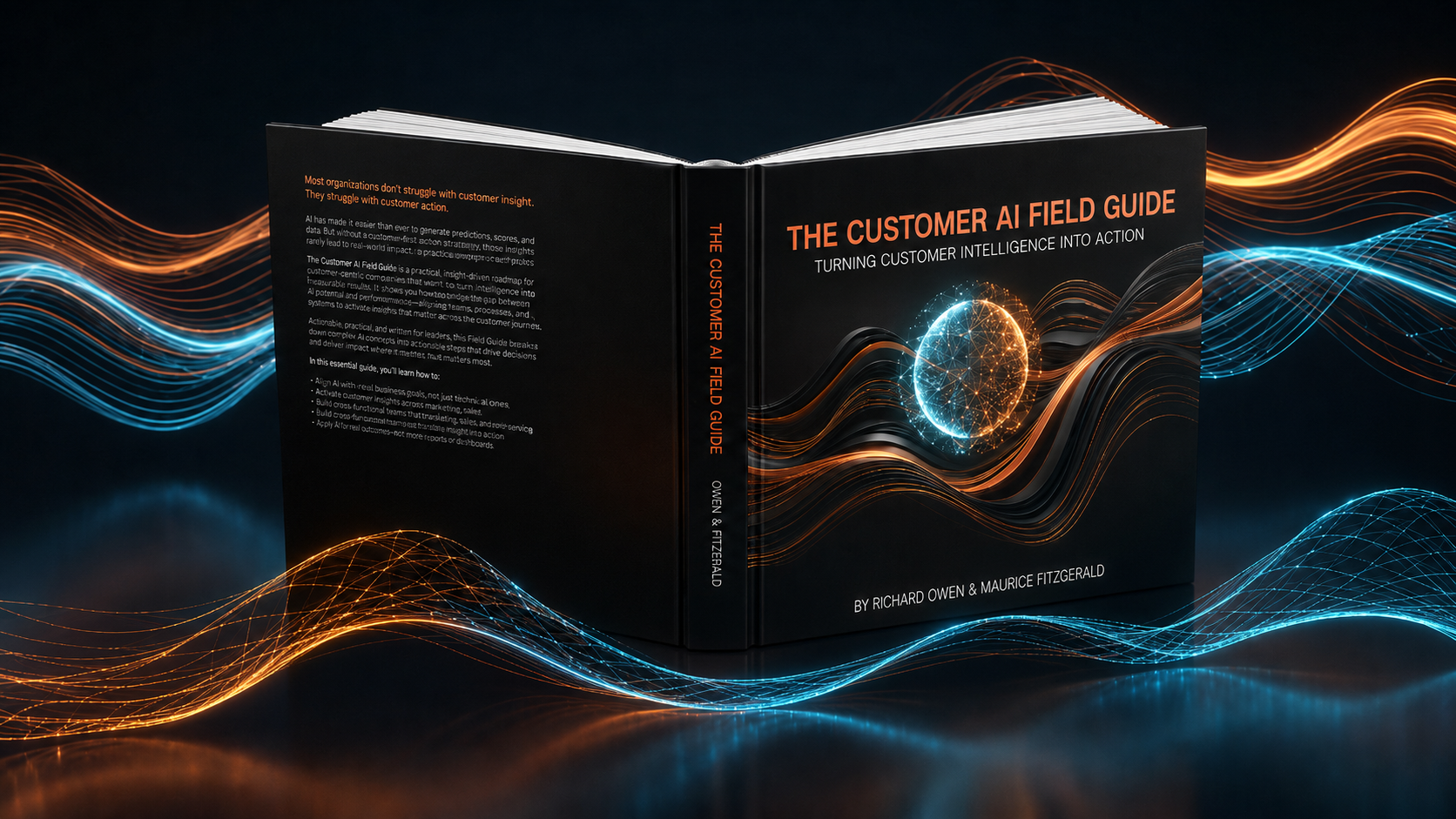
If you've been reading Field Notes, you know the problem isn't awareness - it's execution. Knowing that AI can improve retention or accelerate revenue doesn't tell you how to make it happen in your organisation. That's exactly the gap The Customer AI Field Guide was written to close. Authored by Richard Owen and Maurice FitzGerald (that's us), it's a practical execution guide for CX, CS, and RevOps leaders, covering how to identify at-risk accounts before they signal churn, convert customer insights into frontline action, build the financial case that gets CFO sign-off, and design Customer AI systems your teams will actually adopt. Theory optional. Results required.
[ Get the Customer AI Field Guide → Now on Amazon]
Field Notes publishes every Tuesday. Each edition focuses on one topic - a trap, a framework, a field observation, or a pattern worth examining. If something in here resonates, or if you're seeing something different in your own programs, we'd like to hear about it.

Responses