
By Richard Owen & Maurice FitzGerald
Field Notes on Customer AI · Edition 012 · July 21st, 2026
Each Tuesday, Field Notes on Customer AI surfaces what we're seeing in the field: patterns from implementations, ideas worth stress-testing, and the occasional inconvenient truth about how Customer AI programs succeed or stall. No abstractions. No product pitches. Just the working knowledge that tends to matter.
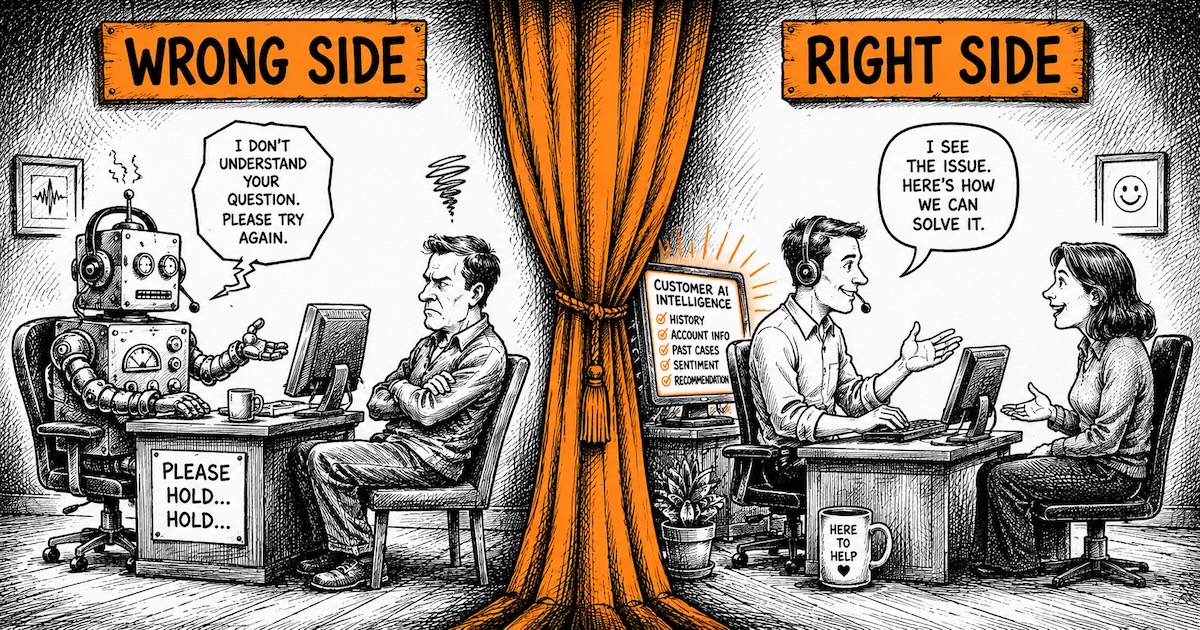
This time we are going to talk about a specific subset of the overall world of Customer AI, which is contact centers. There is some new research out on the topic: the positioning of AI on what we see as the wrong side of the human in the world of contact centers. It's a subset of the overall world of Customer AI and it is an important one.
If you like what you read, please forward this to your colleagues and friends suggesting they learn more about customer retention and growth by subscribing here.
The Field Read
The AI is on the wrong side of the human - Richard Owen
Three independent studies on AI-augmented contact-centre agents, conducted across different industries and measuring different outcomes, point in the same direction.
A Stanford and MIT study tracked 5,179 agents at a Fortune 500 software company. Issues resolved per hour rose fourteen to fifteen percent. A Harvard Business School analysis of over 250,000 chat conversations found that AI-assisted agents responded twenty percent faster and scored higher on both empathy and thoroughness, with the most significant gains concentrated among the least experienced staff. DTE Energy, after deploying augmentation in its contact centre, reduced case duration by thirty-eight percent and agent attrition by ninety-four percent! These are not three versions of the same study. They measure productivity, quality, and retention across different industries and methodologies. The consistency of direction is the finding.
The Harvard result deserves a closer look. Contact centres run annual attrition between thirty and forty-five percent, and the agents most likely to leave are the ones who have not yet developed the confidence to handle complex cases. AI augmentation compresses that development curve: a new agent with AI assistance performs closer to an experienced one, earlier. The retention implication follows naturally.
The deployment configuration is what makes it work. The guardrail problem largely disappears when AI sits behind the agent rather than in front of the customer. The agent owns the conversation. The AI compresses the time to find the right answer. Most companies ask how many agents can be replaced. The augmentation evidence supports a different question: how much does each agent improve, and what does that improvement mean for the interactions that determine whether customers stay? In financial services, where a mishandled dispute creates a compliance exposure, the answer to the second question is considerably more valuable.
Read the full article: "The AI is on the wrong side of the human" →
The Practitioner's Take
The banking customer who started to go silent – by Maurice FitzGerald
At HP, our enterprise security software had a large installed base in financial services. I had the pleasure of meeting two of them at their HQ buildings, both of which happened to be at Canary Wharf, in London. That's where I finally understood that inbound cases to our support team carried regulatory weight. A miscommunicated workaround could trigger a compliance review. An unresolved vulnerability could become a reportable incident.
Our support team had about 25% annual attrition, which is actually better than average for this type of work. Every new team member spent months learning the product, the regulatory context, and the various clients' escalation rules. By the time they would usually become competent, some had already left. One bank's CISO told me something I have never forgotten: "Your product is fine. Your support experience is making us consider alternatives."
We did not have AI augmentation way back then, about 15 years ago. What we had was a knowledge base that required the analyst to know what to search for before they could find it. The new support team members often did not know what to search for. They were guessing, and the banking client could hear them guessing. In the modern age, this is where AI enhancement comes in. Your agents can consult with the AI so they learn more quickly and provide more accurate and useful answers to customers.
So therefore: if your contact centre serves financial services clients, run one number before your next AI evaluation. What does each support agent departure cost in lost knowledge, retraining, and client confidence? That is the number AI augmentation addresses. Replacing support staff with AI does not help at all.
The Field Tactic
Three steps to deploy AI behind the agent, not in front of the customer
- Start with complex cases, not simple ones. The augmentation evidence shows the largest gains on cases requiring knowledge retrieval and contextual judgment. In financial services, these are regulatory queries, dispute resolutions, and multi-product interactions where the cost of a wrong answer is highest. Deploy AI where the stakes justify it, not where chatbot deflection already works.
- Measure agent confidence, not just resolution time. DTE Energy's ninety-four percent attrition reduction was not a productivity metric. It was a signal that agents felt more competent. Add a monthly confidence survey to your agent metrics. The attrition forecast lives in that number.
- Design the escalation before the automation. Forty-seven percent of consumers cited inability to reach a live agent as their biggest frustration with automated service. Before deploying any AI self-service layer, define the escalation path to a human. Make it frictionless and obvious.
The Data Point
Attrition reversal
The number: 94%
That is the reduction in agent attrition DTE Energy achieved after deploying AI augmentation in its contact centre. Industry baseline attrition runs between thirty and forty-five percent annually. The cost of each departure includes recruiting, onboarding, months of sub-par performance, and the client relationships damaged during the learning curve. Verizon separately found an eighty-eight percent satisfaction rate for human-led interactions. That number will not improve by replacing the humans. It will improve by making them better.
Source: DTE Energy; Verizon Consumer Research, 2025; Stanford/MIT, Harvard Business School; cited in Richard Owen, "AI: Wrong Side of Human" (See above).
The Iconoclast Question
The wrong question
Your company's last AI business case for the contact centre calculated how many agents could be replaced. Did anyone calculate what would happen if the agents who stayed became substantially better at their jobs? The two numbers are not the same. One of them is worth considerably more.
The Field Bridge
The Customer AI Masterclass is the certification program Richard built for CX, CS, and RevOps leaders who need to move from survey-dependent reporting to predictive account intelligence. Eight units. Self-paced. Built for practitioners, not data scientists.
[ Explore the Customer AI Masterclass →]
Coming in Future Editions
- The Guardrail is the Problem
- Why NPS was never enough, and what replaces it.
- The Executive Sponsorship issue.
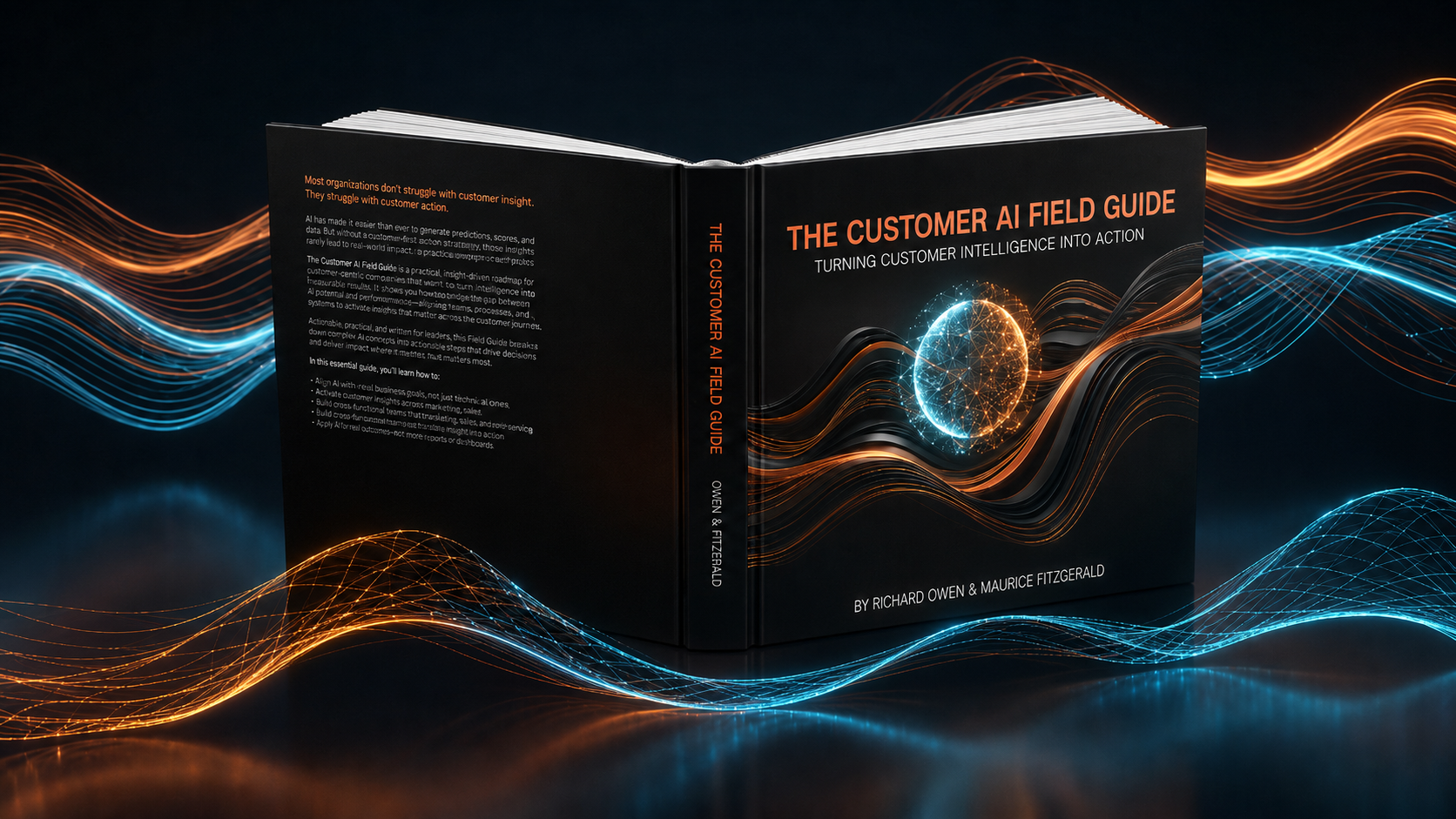
If you've been reading Field Notes, you know the problem isn't awareness - it's execution. Knowing that AI can improve retention or accelerate revenue doesn't tell you how to make it happen in your organisation. That's exactly the gap The Customer AI Field Guide was written to close. Authored by Richard Owen and Maurice FitzGerald (that's us), it's a practical execution guide for CX, CS, and RevOps leaders, covering how to identify at-risk accounts before they signal churn, convert customer insights into frontline action, build the financial case that gets CFO sign-off, and design Customer AI systems your teams will actually adopt. Theory optional. Results required.
[ Get the Customer AI Field Guide → Now on Amazon]
Field Notes publishes every Tuesday. Each edition focuses on one topic - a trap, a framework, a field observation, or a pattern worth examining. If something in here resonates, or if you're seeing something different in your own programs, we'd like to hear about it.

Responses