By Richard Owen & Maurice FitzGerald
Field Notes on Customer AI · Edition 011 · July 14th, 2026
Each Tuesday, Field Notes on Customer AI surfaces what we're seeing in the field: patterns from implementations, ideas worth stress-testing, and the occasional inconvenient truth about how Customer AI programs succeed or stall. No abstractions. No product pitches. Just the working knowledge that tends to matter.
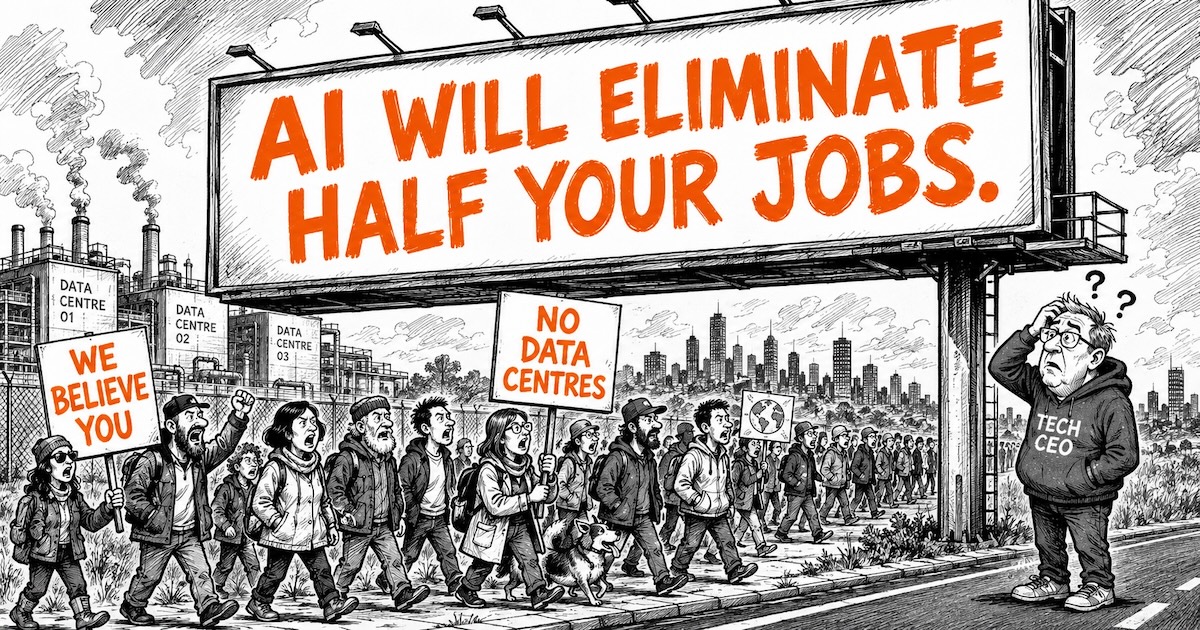
There is quite a lot of media coverage on what we discuss this time: The AI industry built a fear narrative to attract capital. Then the public heard it too. We predicted the outcome of this back in May. Are we psychic?
If you like what you read, please forward this to your colleagues and friends suggesting they learn more about customer retention and growth by subscribing here.
The Field Read
They Believed Us. Who Knew? - Richard Owen
The AI industry spent three years telling the market its technology would eliminate half of all white-collar jobs. Anthropic's CEO predicted twenty-percent unemployment within five years. Shopify told employees no one could hire until they proved the work could not be done by AI. The message was consistent and unambiguous: this technology will replace you.
Then the industry acted surprised that people believed it.
Artificial intelligence is now less popular with Americans than ICE. Communities have blocked forty-eight data-centre projects worth $156 billion. Someone threw a Molotov cocktail at Sam Altman's house. Roughly 360,000 Americans have joined Facebook groups opposing AI facilities, which is approximately 360,000 more people than have joined Facebook groups in favour of anything since 2019.
The fear narrative served three audiences, and each heard a different frequency. Investors heard capability: if AI replaces half the workforce, the total addressable market is measured in trillions. AI captured eighty percent of global venture capital in the first quarter of 2026. Corporate boards heard cover: dressing conventional cost cuts as "AI-driven transformation" converts a defensive story into a strategic one. Regulators heard inevitability: technology too powerful to constrain. The narrative was designed for boardrooms and Davos panels. It reached living rooms and city council meetings, where people heard exactly what the words said.
The waste is that a genuinely compelling alternative exists. AI applied not to eliminating the people who talk to customers, but to understanding what customers will do next: which accounts are at risk, which operational patterns predict renewal and which predict departure. That is AI as a growth engine rather than a cost engine. It creates economic value rather than redistributing it from employees to shareholders. The fear-mongering is not just politically self-destructive. It represents a failure of imagination.
Read the full article: "They Believed Us. Who Knew?" →
The Practitioner's Take
A Lesson from Mark Hurd – by Maurice FitzGerald
Mark Hurd (R.I.P.) was one of the world’s greatest experts in cost reduction. I was present when he once explained the principal difficulty he faced to the HP EMEA leadership team. (Mark was our CEO at the time.)
“When I started to talk about where we would get the money to invest in doubling the size of the sales force, I did my best to spend half my time talking about growth and the other half about cost. Whenever I had just spoken to a group of employees, I got into the habit of asking people around me what I had just spoken about. With the 50:50 time distribution, everyone told me I had only spoken about cost reduction. I found that I had to spend over 80% of the time on growth before the audiences would accept that I said anything at all about growth.”
The AI industry is making the same mistake at scale. The growth and cost reduction messages are being communicated simultaneously and all that most people hear is that they are likely to lose their jobs.
So therefore: the next time you communicate an AI initiative internally, read the opening sentence out loud. If a reasonable person hears "this technology will replace you," everything that follows is noise.
The Field Tactic
Three ways to spot an AI-washed cost decision
-
Lead with the growth story. When presenting Customer AI to your team, open with what the technology reveals rather than what it replaces. "We can now identify at-risk accounts three months before renewal" is a growth story. "We are automating the survey analysis process" is a cost story in disguise. The first sentence determines whether your team hears opportunity or threat.
-
Name the fear. Research from King's College London shows a forty-one-point gap between employer and employee optimism about AI. Your team has the same gap. Acknowledge it openly rather than pretending it does not exist. Naming the concern defuses it faster than ignoring it.
-
Show who benefits. The public backlash is driven by the perception that AI's economic benefits flow to wealthy investors and large companies, not to workers. Inside your organisation, the same perception applies. Demonstrate how AI makes the CX team's work more valuable, not less necessary.
The Data Point
Less Popular than ICE
The Popularity Problem
Artificial Intelligence is now viewed less favourably by Americans than Immigration and Customs Enforcement, according to a Wall Street Journal analysis published this month. Over seventy percent of Americans say AI is advancing too quickly. Only five percent of registered voters are "very positive" about AI in a recent NBC survey. Communities have blocked or delayed $156 billion in data-centre projects. The industry that claimed its technology would eliminate jobs is discovering what happens when the public takes the claim at face value.
Source: Wall Street Journal, May 2026; NBC News/Axios polling, 2026; cited in Richard Owen, "They Believed Us. Who Knew?" (See above).
The Iconoclast Question
The Opening Question Test
When your company last communicated an AI initiative to employees, did the opening sentence describe what the technology would create or what it would eliminate? The answer tells you which narrative your people are carrying into every customer conversation.
The Field Bridge
The Customer AI Masterclass is the certification program Richard built for CX, CS, and RevOps leaders who need to move from survey-dependent reporting to predictive account intelligence. Eight units. Self-paced. Built for practitioners, not data scientists.
[ Explore the Customer AI Masterclass →]
Coming in Future Editions
- The Guardrail is the Problem
- Why NPS was never enough, and what replaces it.
- The Executive Sponsorship issue.
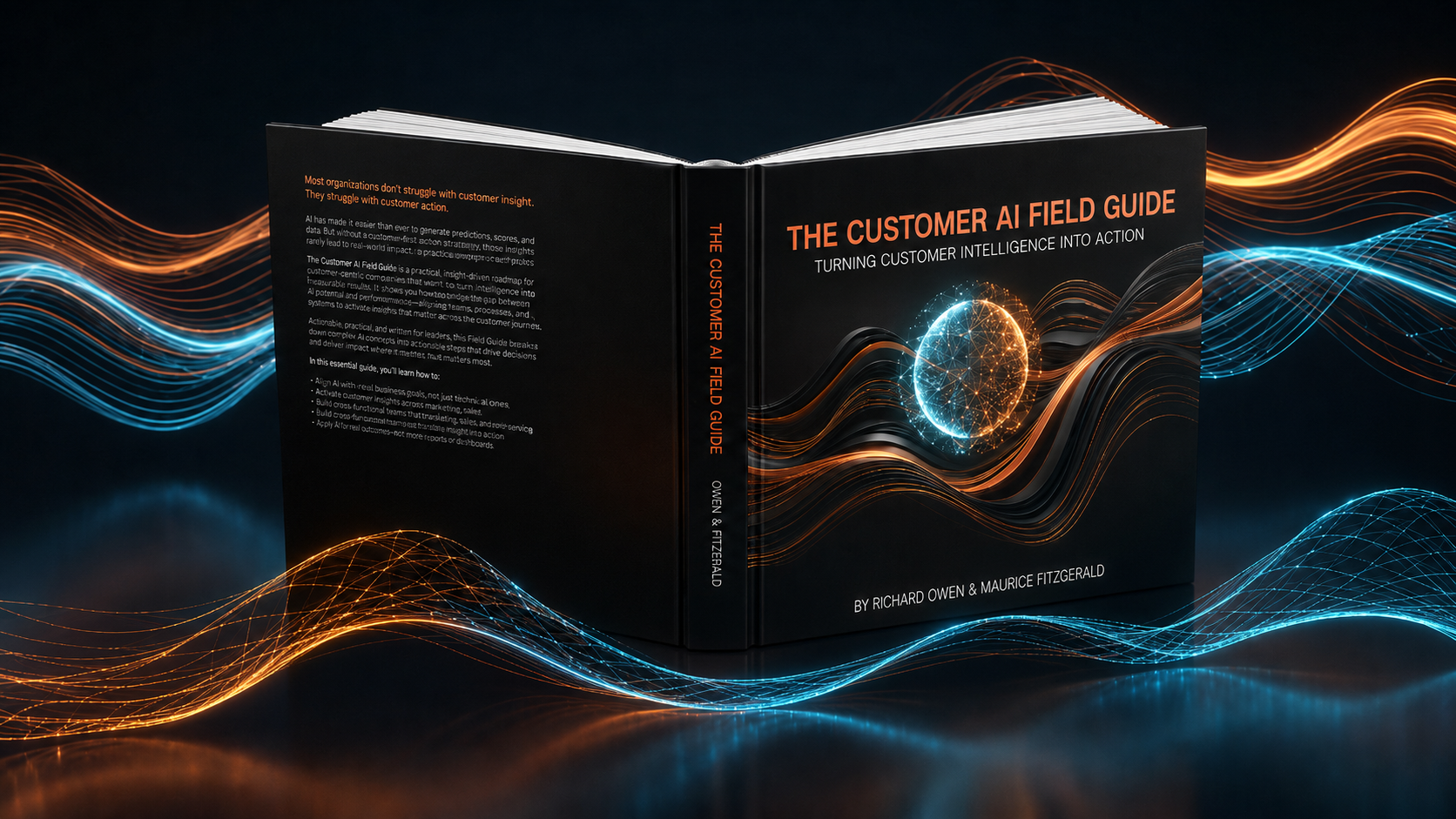
If you've been reading Field Notes, you know the problem isn't awareness - it's execution. Knowing that AI can improve retention or accelerate revenue doesn't tell you how to make it happen in your organisation. That's exactly the gap The Customer AI Field Guide was written to close. Authored by Richard Owen and Maurice FitzGerald (that's us), it's a practical execution guide for CX, CS, and RevOps leaders, covering how to identify at-risk accounts before they signal churn, convert customer insights into frontline action, build the financial case that gets CFO sign-off, and design Customer AI systems your teams will actually adopt. Theory optional. Results required.
[ Get the Customer AI Field Guide → Now on Amazon]
Field Notes publishes every Tuesday. Each edition focuses on one topic - a trap, a framework, a field observation, or a pattern worth examining. If something in here resonates, or if you're seeing something different in your own programs, we'd like to hear about it.

Responses