By Richard Owen & Maurice FitzGerald
Field Notes on Customer AI · Edition 008 · June 16, 2026
Each Tuesday, Field Notes surfaces what we're seeing in the field: patterns from implementations, ideas worth stress-testing, and the occasional inconvenient truth about how Customer AI programs succeed or stall. No abstractions. No product pitches. Just the working knowledge that tends to matter.
This edition covers a topic that is getting quite a lot of press: the financial and investor issues that Medallia, Qualtrics and other platforms face in the age of AI.
The Field Read
The Survey Platform Reckoning - Richard Owen
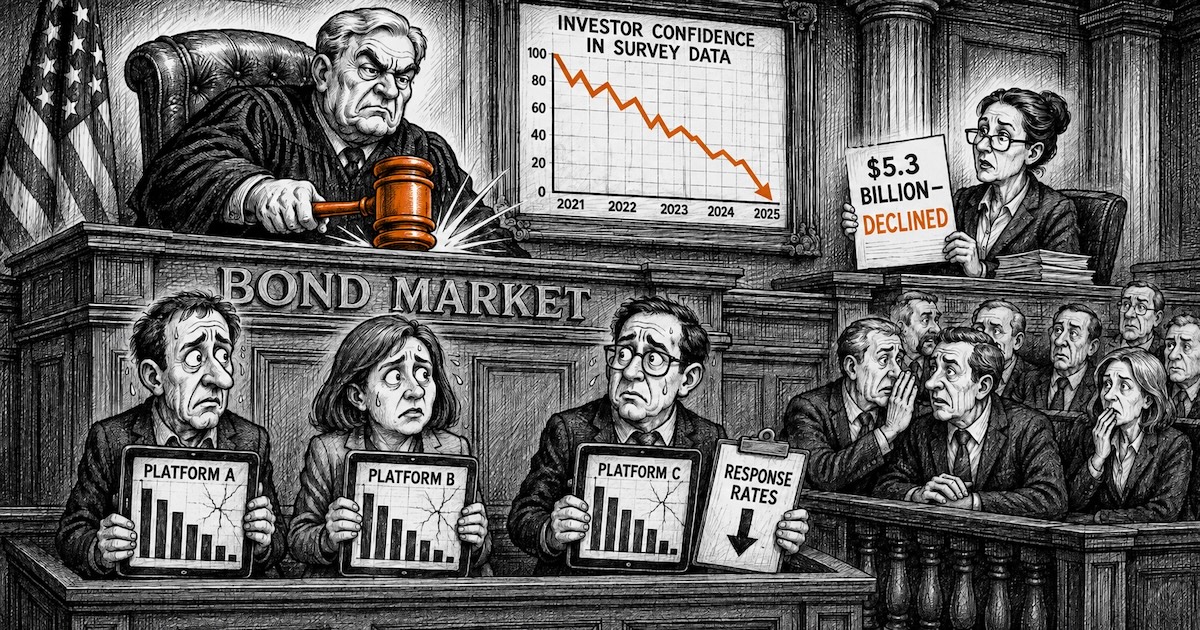
In March, a group of banks led by JPMorgan Chase tried to syndicate $5.3 billion of debt for Qualtrics, earmarked for the company's acquisition of Press Ganey Forsta. The deal would have been the largest consolidation in the Voice of the Customer category. Eleven banks had already committed. It failed.
Bond investors are not paid to have aesthetic preferences about technology categories. They are paid to be right about whether a borrower can service its debt over the life of the investment. When eleven of them walk away from a deal this size and give a single reason, the message is unambiguous. They do not believe the cash flows from the survey software business will be sufficient to repay the loan. Six weeks later, the same message arrived from a different direction. Thoma Bravo handed Medallia to its creditors in a debt-for-equity swap that wiped out most of the equity paid for the company in 2021.
The capital markets and CX practitioners are, through entirely different mechanisms, arriving at the same conclusion. The leading VoC platforms have made real AI investments. Qualtrics has Experience Agents. Medallia has Athena. These are not vaporware capabilities. They do not, on the other hand, fix the problem of customers who never gave feedback in the first place. The AI sits downstream of feedback collection. It processes signals that have already arrived. Customers who do not respond to surveys generate no data for these models to work with, and in most enterprise programs, that is the majority of the customer base.
There is a real distinction between two things that often get conflated. Using AI to make survey processing faster is a genuine efficiency gain. Using AI to build continuous customer understanding from behavioural, operational, profile, and other data, whether or not anyone responds to a survey, is a different capability altogether. The capital markets have, in their own language, told you which one they think the future belongs to.
Read the full article: "The Survey Platform Reckoning" → Here.
The Practitioner's Take
The renewal conversation nobody prepared for - Maurice FitzGerald
At HP, the customer survey platforms used by the various businesses came up for contract renewal on a regular basis. Each time, the conversation followed the same pattern. The vendor presented a roadmap. Our procurement team negotiated price. CX teams confirmed they still needed the dashboards. Nobody asked the harder question: what percentage of our customer base does this platform actually generate insight for?
In a couple of cases, we were paying a seven-figure annual licence to hear from about fifteen percent of our customers. The other eighty-five percent were invisible to the platform entirely. The vendor's response was our response rates were relatively good and that this was not a product limitation in any case. They were right about the first part. They were not right that it absolved them of the second.
The Qualtrics bond failure and the Medallia restructuring have changed the renewal conversation. The question is no longer which survey platform to use. The question is whether a platform where insights are limited by who responds to a survey is worth what you are paying for it, when tools now exist that cover the full customer base without requiring a response at all.
So therefore: no matter what platform you are using, before your next contract renewal, ask one question. What share of your customer base and revenue base does this platform generate insights for, and how is that share changing as survey response rates fall? If the answer is the same as your response rates, be sure to show that number to your CFO together with the contract price.
The Field Tactic
Three questions to answer for your next survey platform renewal:
- Quantify your coverage gap. Pull your last four quarters of survey response data. Calculate the percentage of your customer base represented. Plot the trend. If coverage is declining quarter over quarter, the platform's analytical value is declining at the same rate, regardless of what AI features have been added on top.
- Test the financial connection. Ask your platform vendor to demonstrate, in production and not in a sales deck, a connection between CX signals and financial outcomes such as retention revenue and renewal probability. Gartner has flagged this as the critical missing capability across all category leaders. The test is whether the platform produces that connection routinely, or describes a future in which it might.
- Calculate your fully loaded cost per insight. Divide your total platform cost, including professional services and managed services, by the number of customers the platform actually covers. Compare that per-customer cost to alternatives that cover the full base. The arithmetic should be 'clarifying', to put it politely.
The Data Point
The number:
49 Percentage Points
That is the gap between CX practitioners and consumers on the question of whether customer experience is improving, according to Medallia's own 2026 State of Customer Experience Report. Sixty-six percent of practitioners say CX is improving. Seventeen percent of consumers agree. A gap of that size is not measurement error. It is what happens when an industry measures itself by talking to a small, self-selecting fraction of the people whose opinions actually matter to the business.
The same report found that survey response rates fell eleven percent year over year, and that one in three departments receiving CX insights takes no action on them. The platform that published these findings is the platform whose previous owner just handed it to creditors.
Source: Medallia, 2026 State of Customer Experience Report; cited in Richard Owen, "The Survey Platform Reckoning".
The Iconoclast Question
The Capital Markets Test
When bond investors and your own CX team independently reach the same conclusion about the future of survey-based measurement, which signal are you going to act on first? And what will you tell your board if you wait for a third? Hit reply.
The Field Bridge
The Customer AI Masterclass is the certification program Richard built for CX, CS, and RevOps leaders who need to move from survey-dependent reporting to predictive account intelligence. Eight units. Self-paced. Built for practitioners, not data scientists.
[ Explore the Customer AI Masterclass →]
Coming in Future Editions
- Why Culture Eats Customer AI for Breakfast.
- Enterprise AI Is Failing the Same Way Enterprise IT Always Did.
- Why NPS was never enough, and what replaces it.
- The Executive Sponsorship issue.

If you've been reading Field Notes, you know the problem isn't awareness - it's execution. Knowing that AI can improve retention or accelerate revenue doesn't tell you how to make it happen in your organisation. That's exactly the gap The Customer AI Field Guide was written to close. Authored by Richard Owen and Maurice FitzGerald (that's us), it's a practical execution guide for CX, CS, and RevOps leaders, covering how to identify at-risk accounts before they signal churn, convert customer insights into frontline action, build the financial case that gets CFO sign-off, and design Customer AI systems your teams will actually adopt. Theory optional. Results required.
[ Get the Customer AI Field Guide → Now on Amazon]
Field Notes publishes every Tuesday. Each edition focuses on one topic - a trap, a framework, a field observation, or a pattern worth examining. If something in here resonates, or if you're seeing something different in your own programs, we'd like to hear about it.

Responses