By Richard Owen & Maurice FitzGerald
Field Notes on Customer AI · Edition 014 · August 4th, 2026
Each Tuesday, Field Notes surfaces what we're seeing in the field: patterns from implementations, ideas worth stress-testing, and the occasional inconvenient truth about how Customer AI programs succeed or stall. No abstractions. No product pitches. Just the working knowledge that tends to matter.
This edition covers one of the most critical success factors: how to secure and maintain executive sponsorship as you implement and operate Customer AI, or indeed any significant strategic initiative of any kind.
If you like what you read today, please forward this to your colleagues and friends suggesting they learn more about customer retention and growth by subscribing here.
The Field Read
Executive sponsorship can easily drift away — Richard Owen
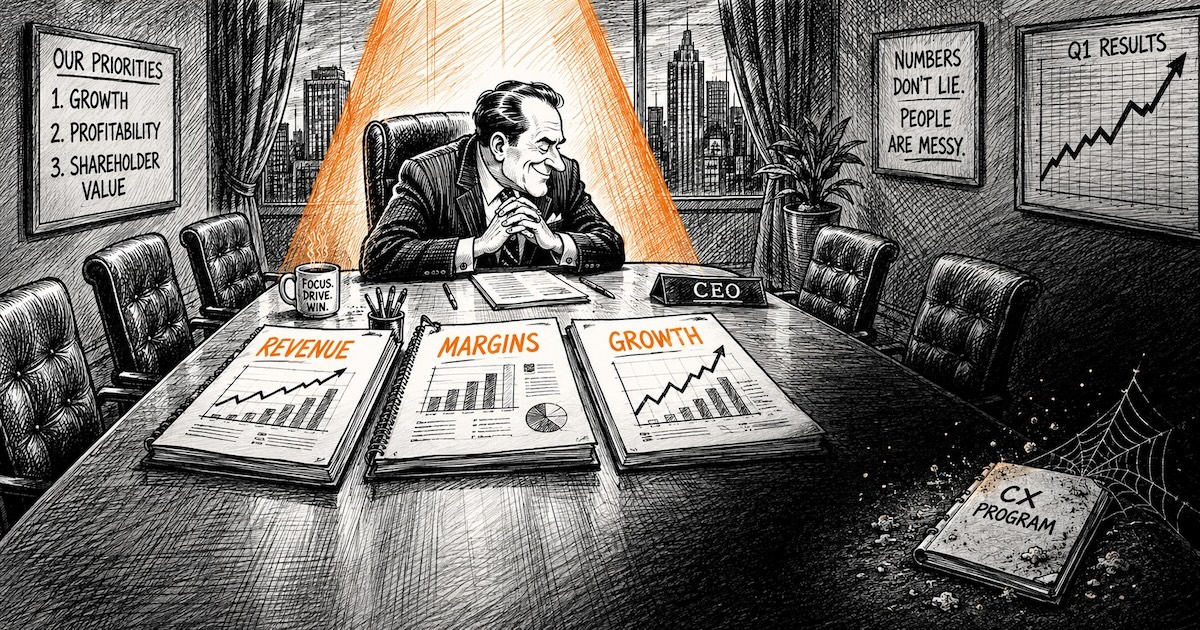
Executive sponsorship for Customer AI programs does not usually end with a dramatic cancellation. It ends with inattention. The budget line survives one more quarter, then another, then gets folded into something else during a corporate reorg of some sort. The program didn't fail, It became invisible.
The mechanism is straightforward. Executives allocate attention the way they allocate capital: toward the things that appear in the metrics they are already tracking. If your Customer AI program reports its progress in NPS or CSAT, and the board is tracking net revenue retention and customer lifetime value, the program has placed itself outside the field of vision of the people who control its funding. It is not that they disagree with what you are doing. It is that they cannot see it.
Mark Templeton, the longtime CEO of Citrix, described the broader version of this problem as "CX washing": boards like to see an NPS number, so someone produces one, with the least effort possible, based entirely on a survey covering a small fraction of customers. Nobody acts on it. Nobody is expected to. The number exists to fill a cell in a quarterly review, and it fills that cell admirably. A Customer AI program built on top of that dynamic inherits the same institutional indifference. It may be doing genuinely valuable work, and the executive committee may even believe that in principle. Belief and budget priority are different things.
New AI capabilities are changing the outlook. The programs that sustain their sponsorship are the ones that predict retention and growth based on both propensity and sentiment. Yes, future customer sentiment can be detected in data, even when it is not driven directly by operational causes. CX leaders must make the connection explicit: here is what we predicted, here is what happened, here is the revenue impact. Not satisfaction language. Financial language. The CFO does not need to understand your model. The CFO needs to see that your model's output shows up in numbers that are already on the operating review.
The test is simple. If your program disappeared tomorrow and nobody in finance or on the leadership team noticed for a quarter, you do not have executive sponsorship. You have tolerance. Tolerance is not a strategy, it is a countdown.
The Practitioner's Take
Richard is right — Maurice FitzGerald
As always, Richard's combination of many years of experience and a deep desire to innovate in the world of customer experience bring us new a valuable insights. His focus on the use of AI to achieve new breakthroughs makes me feel somewhat guilty about my own approaches to the work in the past. I can't really understand why I was so passive, simply accepting what the recognized CX gurus said was "best practice", while observing that a large proportion of my own teams' findings were simply ignored.
Yes, we presented results quarterly and learned to use customer quotes and sometimes video recordings to make some points in a way that senior leaders would remember. However, we were still considered to be marginal members of the corporate community. While I believed leaders understood the basics of NPS and wanted to act on our recommendations, I think two main things prevented us from achieving true executive sponsorship and enthusiam:
- Our input was (correctly) perceived to be based on a small and therefore potentially unrepresentative portion of the population, no matter how we reported progress.
- Our representation of the relationship between customer sentiment and financial impact was not considered credible, because it was infrequent, in the past, and lacked supporting evidence based on operational data.
So therefore: Yes, you need executive sponsorship to be able to move forward with Customer AI and other major strategic initiatives effectively. Count the number of people above you who can explain your program's value without calling you first. If that number is two or fewer, you simply don't have sponsorship. Fix the communication gap about the current and future results before anything else. Remember that credible linkage to financials is the most important point.
The Field Tactic
Three moves this week
Three things to do this week to protect your executive sponsorship:
- Rename the program in revenue language. If your CX or Customer Success initiative has a code name, an acronym, or a label that requires explanation, change it. "Customer AI Churn Reduction Program" survives a cost review. "Project Lighthouse" does not. The name should tell a finance person what it does without any additional context.
- Map your sponsorship network. List every person above you who could explain what your program delivers and why it matters. If the number is fewer than three, identify the two or three additional leaders you need to reach in the next thirty days. Invite yourself into their review meetings. Bring one number that connects your work to their objectives.
- Translate your next milestone into financial language. Whatever your program is about to deliver, express it in terms the CFO already tracks: retention revenue protected, expansion revenue identified, cost of churn avoided. A prediction is interesting. A prediction tied to a dollar figure is fundable..
The Data Point
The number:
90%
That is the proportion of B2B enterprise sales organizations that still rely primarily on intuition rather than advanced analytics, according to Gartner. In practical terms, nine out of ten customer-facing programs cannot show their executive sponsor evidence-based results when budget review arrives.
The programs that fall in the other ten percent have something specific in common: they produce predictions that can be verified against outcomes. "We predicted these forty accounts were at risk; thirty-seven renewed at lower value or left." That sentence is worth more to an executive sponsor than any dashboard, because it can be checked. Verifiability is what turns a program from a cost center into a decision tool.
Source: Gartner, cited in OCX Cognition enterprise analytics research.
The Iconoclast Question
This week's provocation
How many people above you in your organization could explain what your Customer AI program does and why it matters, without calling you first? If the number is fewer than three, what happens when one of them leaves?
The Field Bridge
The Customer AI Masterclass is the certification program Richard built for CX, CS, and RevOps leaders who need to move from survey-dependent reporting to predictive account intelligence. Eight units. Self-paced. Built for practitioners, not data scientists.
[ Explore the Customer AI Masterclass →]

If you've been reading Field Notes, you know the problem isn't awareness - it's execution. Knowing that AI can improve retention or accelerate revenue doesn't tell you how to make it happen in your organisation. That's exactly the gap The Customer AI Field Guide was written to close. Authored by Richard Owen and Maurice FitzGerald (that's us), it's a practical execution guide for CX, CS, and RevOps leaders, covering how to identify at-risk accounts before they signal churn, convert customer insights into frontline action, build the financial case that gets CFO sign-off, and design Customer AI systems your teams will actually adopt. Theory optional. Results required.
[ Get the Customer AI Field Guide → Now on Amazon]
Field Notes publishes every Tuesday. Each edition focuses on one topic - a trap, a framework, a field observation, or a pattern worth examining. If something in here resonates, or if you're seeing something different in your own programs, we'd like to hear about it.

Responses