By Richard Owen & Maurice FitzGerald
Field Notes on Customer AI · Edition 010 · July 7th, 2026
Each Tuesday, Field Notes surfaces what we're seeing in the field: patterns from implementations, ideas worth stress-testing, and the occasional inconvenient truth about how Customer AI programs succeed or stall. No abstractions. No product pitches. Just the working knowledge that tends to matter.
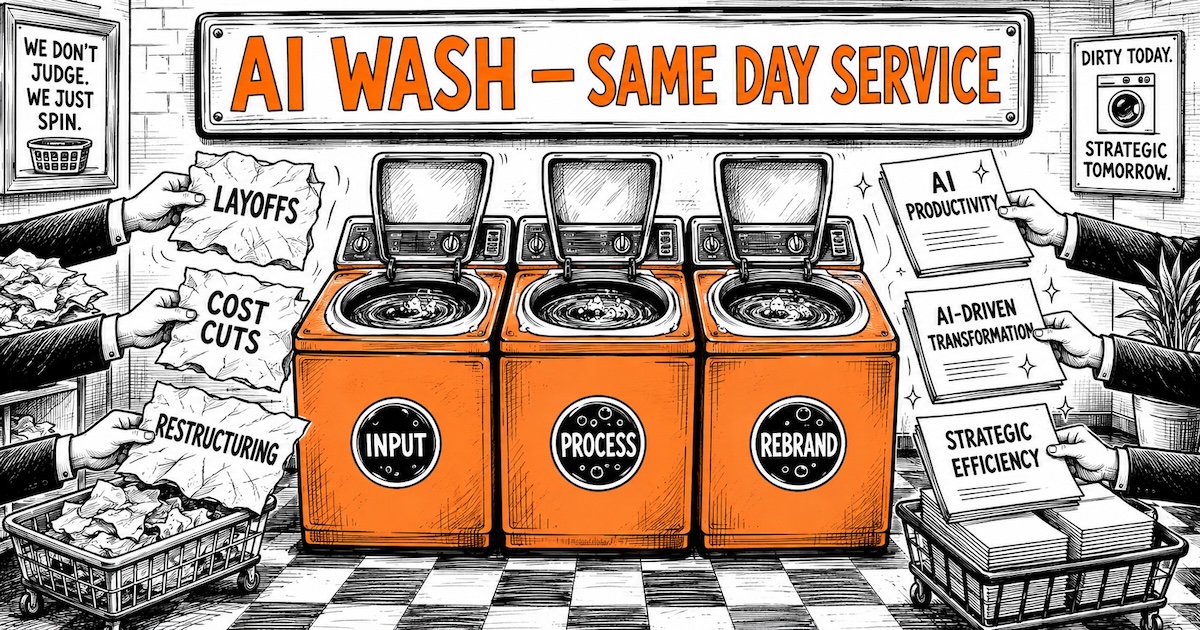
We are sure you have seen loads of examples of what we cover this time: hiding the real purpose of layoffs and other actions by attaching an AI label to them. For example, 56% of this year's layoff announcements cite AI. We say that's not really what's going on.
If you like what you read, please forward this to your colleagues and friends suggesting they subscribe. There is a subscription link at the bottom of this web page.
The Field Read
AI-Washing the Income Statement - Richard Owen
56% of workforce reductions announced this year have cited AI, automation, or machine learning as the reason. An uncomfortable share of them are not, on examination, AI-driven at all. They are conventional cost decisions dressed in the vocabulary the market is currently rewarding.
Oracle's 18% headcount cut was framed as AI productivity. It was, in financial terms, a substitution of capital expenditure for operating expenditure: people for chips. The cash freed by severance is being redirected into a data-centre buildout the company has committed to with hyperscaler customers. That is a defensible capital decision. It is not an AI productivity gain. Meta's 10% reduction took headcount back to its 2021 level, which is a correction of a hiring binge that several insiders have characterised as a mistake. In any prior decade, reversing a 2021 hiring decision would have been described as reversing a 2021 hiring decision. The current vocabulary makes more flattering options available. Microsoft's 7% layoff lands the company at its 2022 headcount, still 47% above pre-pandemic baseline. Tesla announced an AI productivity initiative in March and a demand-driven workforce reduction in April. The two have been treated as the same announcement by an audience encouraged to combine them.
The structural reason is worth naming. Each of these firms has monetised the proposition that AI is transformative. A disclosure that says "AI is producing measurable productivity in our own operations" does double duty: it explains a cost cut that would otherwise need a less flattering explanation, and it reinforces the market narrative the firm's valuation depends on. You could think of it as sell-side research without the disclaimer. The counterfactual test is simple: would this headcount decision have been made anyway? In most current cases, the calendar answers for you.
Read the full article: "AI-Washing the Income Statement" →
The Practitioner's Take
The restructuring that got a new name – by Maurice FitzGerald
At Compaq, about a year before the HP merger closed, we went through a restructuring that reduced the European services team by something like 15%. The services margin had dropped below some executive committee objective, and the headcount was adjusted to match. It was an unpleasant process. It was also an honest one.
If that restructuring happened today, I suspect the announcement would mention AI. Not because AI had anything to do with it; simply because the preferred vocabulary has changed. "We are restructuring to align costs with revenue" sounds defensive. "We are investing in AI-driven productivity" sounds strategic. The same decision, described in the language the market is currently using, becomes a different story.
I watch CX teams go through versions of this now. A platform renewal eliminates three analyst positions. The AI explanation is more marketable. The internal announcement credits the AI.
So therefore: the next time you see a competitor announce AI-driven productivity gains, apply the counterfactual test. Would they have made the same decision without AI? If the answer is yes, what you are reading is a press release, not a productivity story.
The Field Tactic
Three ways to spot an AI-washed cost decision
-
Check the timing. If the headcount decision was scheduled or under discussion before the AI deployment was operational, the AI is at best a coincidental event. The calendar is the simplest diagnostic, and the one most press releases hope you will not consult.
-
Test the demand environment. Firms reporting AI-driven cost savings during periods of declining demand, are actually reporting savings that would have appeared as conventional reductions in any case. Reasonably easy for you to check.
-
Look at where they say the freed-up cash is being spent. If the savings are being redirected into AI-related capital expenditure, the firm has substituted capital for labour. That is a different financial story from a productivity gain, and a disclosure that lets both versions exist in the same paragraph is double-counting, in our opinion.
The Data Point
The Number: 56%
The AI-Washing Ratio
That is the share of workforce reductions at large companies in 2026 that explicitly cite AI, automation, or machine learning as the reason, according to the SkillSyncer 2026 Tech Layoffs Tracker. A Forrester report published in January found that many of the companies announcing AI-related layoffs do not have mature AI applications ready to fill the vacated roles. An MIT professor studying the pattern described AI as "a perfect excuse to justify big layoffs." The layoffs are real. The AI attribution, in a non-trivial number of cases, is not.
Source: SkillSyncer 2026 Tech Layoffs Tracker; Forrester, January 2026; cited in Richard Owen, "AI-Washing the Income Statement" (See above).
The Iconoclast Question
The Counterfactual
Your company announced AI-driven productivity savings last quarter. If the AI deployment had not occurred, would the same headcount decision have been made anyway? If you are not certain the answer is no, what exactly did the AI produce?
The Field Bridge
The Customer AI Masterclass is the certification program Richard built for CX, CS, and RevOps leaders who need to move from survey-dependent reporting to predictive account intelligence. Eight units. Self-paced. Built for practitioners, not data scientists.
[ Explore the Customer AI Masterclass →]
Coming in Future Editions
- They believed us. Who knew?
- Why NPS was never enough, and what replaces it.
- The Executive Sponsorship issue.

If you've been reading Field Notes, you know the problem isn't awareness - it's execution. Knowing that AI can improve retention or accelerate revenue doesn't tell you how to make it happen in your organisation. That's exactly the gap The Customer AI Field Guide was written to close. Authored by Richard Owen and Maurice FitzGerald (that's us), it's a practical execution guide for CX, CS, and RevOps leaders, covering how to identify at-risk accounts before they signal churn, convert customer insights into frontline action, build the financial case that gets CFO sign-off, and design Customer AI systems your teams will actually adopt. Theory optional. Results required.
[ Get the Customer AI Field Guide → Now on Amazon]
Field Notes publishes every Tuesday. Each edition focuses on one topic - a trap, a framework, a field observation, or a pattern worth examining. If something in here resonates, or if you're seeing something different in your own programs, we'd like to hear about it.

Responses