AI-Washing the Income Statement
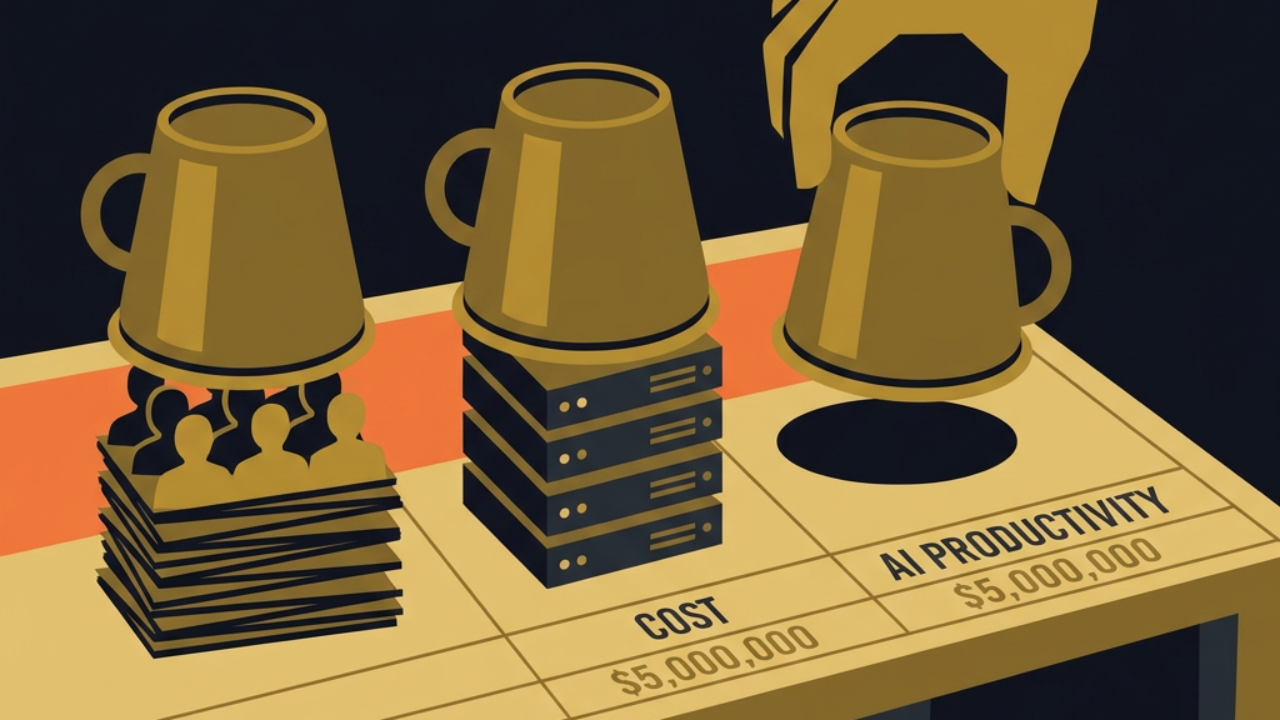
The largest US technology firms have spent the last twelve months issuing disclosures that attribute workforce reductions to AI-driven productivity gains. Some are accurate. Most are not. The firms with the widest gap between the disclosed cause and the operating cause are also, almost without exception, the firms whose public valuations depend on AI being seen to be transformative. Not a coincidence. A structural reason to read the disclosures differently than they're currently being read.
There's a related argument I've made elsewhere. Rory Sutherland's prediction that AI would be sold as cost reduction because cost reduction is the easiest way to recover the spend, and the broader point that AI deployed as headcount reduction is moving value around the income statement rather than creating it, is the strategy critique. This piece isn't the strategy critique. It's the disclosure critique. The strategy critique says: AI as cost reduction is the wrong AI strategy. The disclosure critique says: some of what's being disclosed as AI cost reduction isn't, on examination, AI cost reduction at all. Two related arguments, two different implications, and the disclosure version is the one most relevant to anyone trying to read the AI productivity story from outside the firms producing it.
Two questions follow. What should an investor make of the disclosures themselves, and what does the pattern of disclosures tell us collectively about how much AI productivity the economy is actually generating right now.
What the disclosures look like under examination
Four of the most widely covered workforce decisions of the last quarter have been attributed, in part or in whole, to AI productivity gains. None of them, on close examination, actually are.
Oracle announced an eighteen-percent workforce reduction in March, against a public projection of negative free cash flow until 2030. The reduction was framed in the language of AI productivity. It was, in straightforward financial terms, a substitution of capital expenditure for operating expenditure: people for chips. The chips do not generate severance liabilities. The chips also do not require the firm to explain, three quarters from now, what happened to the work the eighteen percent of the workforce was previously doing. The cash freed by the headcount cut is being redirected into the data-center buildout the company has committed to with its hyperscaler customers. That is a defensible capital decision. It isn't an AI productivity gain. The work being done by those eighteen percent has been deferred or absorbed by the remaining workforce, and the cost of the absorption will appear in attrition data, customer-implementation timelines, and product-roadmap slippage over the next four to six quarters.
Meta's ten-percent workforce reduction in March took the company's headcount back to its 2021 level — meaning the reduction was, in payroll terms, a return to pre-bubble headcount rather than an AI displacement. Meta's headcount in 2021 was already considered large by the standards of comparable firms. The cuts being announced as AI productivity are reversing a hiring binge that several insiders have, in interviews, characterised as a mistake. Reversing a 2021 hiring decision, in any prior decade, would have been described as reversing a 2021 hiring decision. The current vocabulary makes more flattering options available.
Microsoft's seven-percent layoff target lands the company at its 2022 headcount level, still forty-seven percent above its pre-pandemic baseline. Microsoft is generating real AI productivity gains in its commercial cloud and developer-tooling businesses. The current round of layoffs is unrelated to those gains. The disclosure, in its compressed form, has not gone out of its way to draw the distinction.
Tesla announced an AI-driven productivity initiative in March and a ten-percent workforce reduction in April. The April reduction was attributed, in the company's own filings, to weak demand. The two announcements were a month apart. They have been treated, in the public narrative, as the same announcement, by an audience that has been encouraged to do the work of combining them. This is not an arrangement the firm has asked to be discontinued.
Each of these is a workforce decision the firm would have made anyway, dressed in the vocabulary of AI productivity because that vocabulary is what the market is currently paying for.
The conflict of interest the disclosures will not declare
There's a structural reason these four firms in particular are the ones producing this pattern. Each has, in one form or another, monetized the proposition that AI is transformative. Oracle's data-center buildout depends on hyperscaler customers continuing to expand AI training and inference spend. Meta is in the middle of building one of the largest consumer-AI inference platforms in the world and has tied a substantial portion of its forward valuation to its success. Microsoft's commercial cloud growth has been substantially driven by AI workload migration and the Copilot product family. Tesla has rebuilt its public valuation thesis around full self-driving and humanoid robotics. For each of them, a disclosure that says "AI is producing measurable productivity gains in our own operations" does double duty. It explains a workforce reduction that would otherwise need a less flattering explanation, and it reinforces the broader market narrative that AI is, in general, the transformative technology the firm's valuation depends on it being.
The firms with the largest financial interest in a given proposition have always tended to produce the largest volume of evidence in support of it. This isn't new, and it isn't unique to AI. It's the part of disclosure investors have always been required to discount on their own.
There's a financial parallel for the pattern that's worth being explicit about, because it makes the diagnostic question easier to ask out loud. The sell-side research analyst employed by the bank that underwrote the equity offering has, historically, written the buy rating on the offering. The cost of doing this in the open has been managed, over the years, with disclosures that note the relationship and let the reader discount accordingly. The AI cycle has not yet developed an equivalent disclosure. The investor reading the AI productivity claim, from the firm whose forward valuation depends on AI productivity being real, is — in the relevant sense — reading sell-side research without the disclaimer.
One presumes a fair amount of the corporate communication doing the work of these disclosures has been drafted with the assistance of the very technology the disclosure is celebrating. Whether the AI is helping or hindering is, in the relevant sense, unfalsifiable.
How an investor should read the disclosures
The diagnostic question is straightforward. The reason it's rarely asked out loud is that the answer would, in most current cases, embarrass the disclosure. If the AI deployment had not occurred, would the same headcount decision have been made anyway? The investor reading the disclosure has less detail than the CFO does, but the test is largely the same, and three pieces of evidence point at the answer.
The first is timing. If the headcount decision was scheduled before the AI deployment was operational, the AI is, at best, a coincident event rather than a cause. The disclosure that attributes the saving to AI is making a claim about timing the calendar will not support.
The second is the demand environment. Ernie Tedeschi has pointed out, in the broader labour-market data, that technology rarely displaces a profession during the boom — the boom hides the displacement, the bust forces it. Firms reporting AI-driven cost savings during a period of muted demand growth are, in many cases, reporting savings that would have shown up as bust-driven reductions in any case. Travel agents didn't disappear during the dot-com boom. They disappeared in the bust, and then settled at a permanently lower level when the recovery came. The current AI cycle hasn't yet had its bust. Firms that are pre-booking the savings will likely find, when the bust arrives, that the savings they thought they had already taken were the savings the bust was always going to deliver, and that the new savings the bust will demand are coming on top of an already-thinned cost base.
The third is what the firm is doing with the freed cash. If the cash is being redirected into AI-related capital expenditure — chips, data centres, model training — the disclosure is, accurately, that the firm has substituted capital for labour in pursuit of an AI capability. That's a different financial story from the one the headcount cut is currently being used to tell. The first story is honest about the underlying transaction. The second is, in effect, claiming the productivity gain twice — once on the cost side as the headcount saving and once on the revenue side as the eventual AI-driven uplift. A disclosure that lets both versions sit in the same paragraph is permitting a double count. The investor reading it shouldn't.
What the pattern tells us about AI productivity
This is the half of the question that goes beyond the four firms and is, for any longer-horizon investor, the more important version of the argument.
The macroeconomic data on AI productivity gains has, so far, been muted. BLS productivity is running below trend. The San Francisco Fed's cyclically-adjusted measure shows essentially no movement. The standard reply, from those who think AI is transforming the economy on a horizon shorter than the macro statistics are picking up, has been that the firm-level evidence is the leading indicator and the macro data will catch up. The firm-level evidence, on examination, is mostly the macro data wearing a different costume. There is no leading indicator. There is the macro data, and a set of disclosures that happen to be assembling slightly more flattering versions of it.
The valuation consequence is direct. The Mag 10 trades at a substantial premium to the rest of the S&P, and a meaningful share of that premium rests on the proposition that AI is transforming both the cost base and the addressable revenue of the firms inside it. The disclosures discussed above are the cost-base evidence. If they are not, on examination, evidence of AI productivity, the cost-base half of the Mag 10 premium is being paid for something else. The disclosure does not specify what. The other half — AI-driven revenue growth — is a separate piece, with its own counterfactual problems, that the next downturn will subject to its own version of this examination.
The next downturn will, in fact, do most of the work of resolving this. Tedeschi's recessionary-burst observation suggests displacement deferred during the boom arrives in the bust, and firms whose AI productivity claims weren't actually AI productivity claims will discover, alongside the rest of us, that the savings they took as productivity were the savings the bust would have forced anyway. Investors who priced those savings as structural will need to revise. Investors who priced them as bust-resilient will need to revise harder. The standalone version of this argument — what the recovery composition of the workforce will look like, and what an operator can do about it now — is in a separate companion piece. The implication for investors is narrower. The savings that look structural in the boom-time disclosure will, in the bust-time disclosure, separate cleanly into the savings that were always coming and the savings AI actually produced. The two will be priced differently. Investors who can do the separation in advance will be ahead of the disclosure cycle that's currently running about a year behind the operating reality.
What an investor should do about it
The practical implication is narrow and worth saying plainly. AI-attributed cost disclosures from firms with significant exposure to the AI capex narrative should be read with the counterfactual question attached. Would this cost decision have been made anyway? The three tests above are sufficient to answer the question for most current cases. Any disclosure that fails one of the three is best treated as a coincident event rather than a productivity gain, and the implied saving best treated as bust-driven rather than structural. The valuation that has been built on the consolidated disclosure should be re-examined against the un-consolidated version.
The longer-horizon position is harder, and worth being honest about. If the most-cited firm-level evidence that AI is transformative is not, in fact, evidence that AI is transformative, then the question of where the productivity gains actually live is more open than the consensus implies. A more honest answer is that AI is producing real productivity in narrow, well-specified deployments inside specific functions, and the macro and firm-level evidence will catch up to those gains on a horizon longer than the current Mag 10 multiple is built around. The firms that look prescient at the end of the decade will be the ones whose 2026 disclosures were quieter, more specific, and more honest about which gains were AI and which were the bust quietly arriving in advance. The firms producing the loudest disclosures right now are not, on the available evidence, in that group.
The disclosure regime is not currently distinguishing the two. The investor will have to. Investors who learn to read AI productivity disclosures with the counterfactual question attached will look prescient by the end of the cycle. Investors who don't will discover, somewhere in 2027 or 2028, that "AI productivity" was, in a non-trivial number of cases, a euphemism — and that euphemisms are not, on the historical record, a class of asset that holds its value through the next downturn.
I'm Richard Owen, founder and CEO of OCX Cognition. We build predictive customer analytics for companies who'd prefer to know which customers are at risk before those customers have already decided to leave.