By Richard Owen & Maurice FitzGerald
Field Notes on Customer AI · Edition 004 · May 19, 2026
Each Tuesday, Field Notes surfaces what we're seeing in the field: patterns from implementations, ideas worth stress-testing, and the occasional inconvenient truth about how Customer AI programs succeed or stall. No abstractions. No product pitches. Just the working knowledge that tends to matter.
This edition covers another uncomfortable subject: The systems used by five different functions in your company may have five completely different views of the same customer.
The Field Read
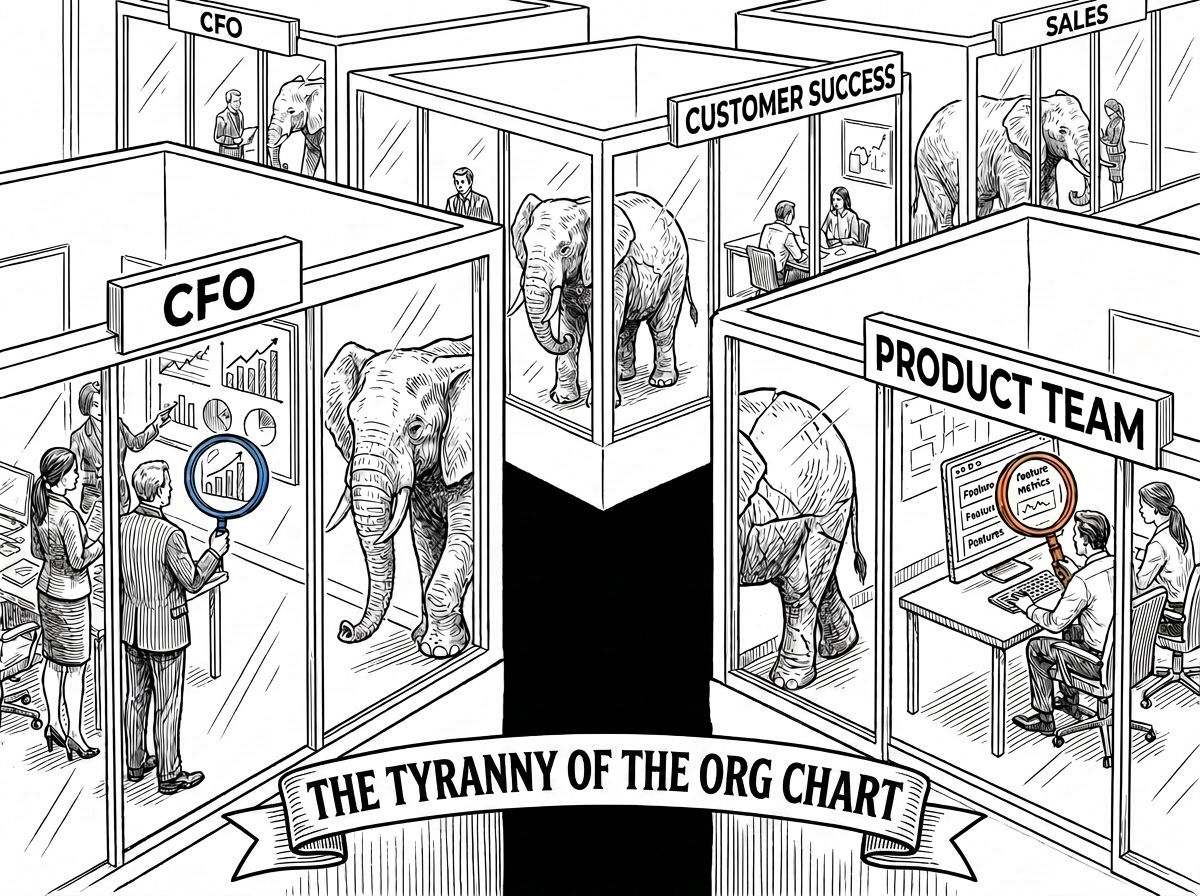
The Tyranny of the Org Chart - Richard Owen
Ask a CFO about a customer and you will hear about revenue, contract value, and payment history. Ask sales and you will hear about pipeline and the last executive conversation. Ask customer success and you will get a health score and a list of open issues. Ask the product team and you will learn about feature usage and support tickets. Each answer is accurate. None of them is the customer.
This is the silo problem, and it is more pervasive than most leaders realize. Not because the silos are hidden, but because the software industry has spent two decades building increasingly specialized tools that make the fragmentation feel natural. There is a platform for CRM, a platform for customer experience, a platform for customer success, a platform for revenue operations, a platform for support. Each is sophisticated and genuinely useful within its domain. Collectively, they ensure that nobody in the organization sees the customer as a whole. You could think of it as asking five people to describe an elephant and then buying each of them a very expensive magnifying glass that allows them to look at only the ears, or the trunk, or some other part of its body.
The customer, meanwhile, experiences your company as a single entity. Their assessment of whether the relationship is working is a holistic judgment that synthesizes everything. The gap between how the customer experiences you and how you understand the customer is where value destruction happens. A customer who has high product adoption and eroding executive engagement is at risk, even though the product team's metrics look healthy. A customer whose support tickets are resolved quickly and whose business outcomes are not being achieved is dissatisfied, even though support shows green.
None of these contradictions are visible through functional lenses. The most important customer problems are the ones that fall through the gaps between functions, and the gaps are where nobody is looking.
["The Tyranny of the Org Chart" → Read full article]
The Practitioner's Take
Four Dashboards, One Missing Customer - Maurice FitzGerald
At HP Software, we had separate dashboards for every function. Sales tracked pipeline. Support tracked resolution times. My team tracked relationship NPS. Finance tracked contract value. Each system was good at what it did. None of them talked to the others.
I remember an account where sales reported a healthy expansion opportunity, support reported low ticket volume, and my CX data showed NPS had dropped fifteen points over two quarters. Nobody connected the three pictures. The renewal conversation revealed the customer had already signed with a competitor.
Each team's data was accurate. The composite picture existed nowhere. The enemy was outside the company, not inside; and yet we were so occupied maintaining our separate views of reality that the competitor walked away with the account. They did not have better information. They had fewer internal walls.
So therefore: pick your most important account. Ask sales, support, CS, and product each to describe its health in one sentence. If you get four different answers, you do not have a customer view. You have four functional views and a gap where the customer actually lives.
The Field Tactic
Three Ways to See the Customer as a Single Entity
- Run the four-sentence test. Pick one strategic account. Ask sales, support, customer success, and product management to each describe its health in a single sentence. Read the four sentences side by side. If they describe four different customers, the silo is not a theory. It is your operating reality, and it is worth showing to your leadership team exactly as it is.
- Map one cross-functional churn. Take a recently lost account and ask each function what their data showed in the six months before departure. Map the contradictions. In most cases, at least one function had a signal that would have changed the outcome if anyone else had seen it. Present the composite timeline to leadership.
- Identify the orphan signal. Find one customer indicator that currently lives in nobody's dashboard: declining executive sponsor engagement, a usage shift that crosses functional boundaries, a pattern in invoice disputes. Assign it an owner. Signals without owners are signals without consequences.
The Data Point
The number - the Customer 360 Graveyard:
16%
That is the share of organizations that have achieved a functioning Customer 360 view, according to Gartner, despite it being among the most commonly stated CX objectives. Gartner further estimates that 80% of organizations still pursuing that vision will abandon it, because the approach fails to deliver usable intelligence or runs into data governance constraints that make aggregation unsustainable.
The pattern is clear. Nearly everyone agrees that the fragmented customer view is the problem. Almost nobody has solved it by treating it as a data integration project. The organizations that get there treat it as an intelligence problem instead.
Source: Gartner
The Iconoclast Question
The System Count
How many systems in your company contain customer data? Now: how many of them does your CFO look at? The gap between those two numbers is the size of your silo problem. Feel free to reply to the web version of this newsletter with your count.
The Field Bridge
The Customer AI Masterclass covers how to build a unified customer view that works across functions. Module 4 is where it starts.
[ Get Certified → $500 off through May 31, use code LEADER500]
Coming in future editions
- Iceberg Dead Ahead? Customer Portfolio Management is Not a Game.
- Prevention Economics.
- Bad Survey Data or Pure Guesswork? A Better Solution to Both.
- Why NPS was never enough, and what replaces it.
- The Executive Sponsorship issue.

If you've been reading Field Notes, you know the problem isn't awareness — it's execution. Knowing that AI can improve retention or accelerate revenue doesn't tell you how to make it happen in your organisation. That's exactly the gap The Customer AI Field Guide was written to close. Authored by Richard Owen and Maurice FitzGerald (that's us), it's a practical execution guide for CX, CS, and RevOps leaders — covering how to identify at-risk accounts before they signal churn, convert customer insights into frontline action, build the financial case that gets CFO sign-off, and design Customer AI systems your teams will actually adopt. Theory optional. Results required.
[ Get Field Guide → Now on Amazon]
Field Notes publishes every Tuesday. Each edition focuses on one topic — a trap, a framework, a field observation, or a pattern worth examining. If something in here resonates, or if you're seeing something different in your own programs, we'd like to hear about it.
- Richard Owen & Maurice FitzGerald

Responses