By Richard Owen & Maurice FitzGerald
Field Notes on Customer AI · Edition 003 · May 12, 2026
Each Tuesday, Field Notes surfaces what we're seeing in the field: patterns from implementations, ideas worth stress-testing, and the occasional inconvenient truth about how Customer AI programs succeed or stall. No abstractions. No product pitches. Just the working knowledge that tends to matter.
This edition covers something uncomfortable: Every customer decision you learn about too late is money you already lost.
The Field Read
The Cost of Looking Backwards - Richard Owen
In 'Alice Through the Looking-Glass', the White Queen tells Alice she can remember things that happened the week after next. Alice protests: "I can't remember things before they happen." The Queen's reply is pointed: "It's a poor sort of memory that only works backwards." In Wonderland, a memory that only works backwards is considered a disability. In most enterprise customer programmes, it is considered best practice.
Most customer analytics are, by design, retrospective. They measure what customers felt at the point they were asked. They summarise what happened during the last period. They report on trends that have already established themselves. For a leader trying to understand where the business has been, this is useful enough. For a leader trying to get ahead of what is coming, it is structurally inadequate.
The economics are specific. The cost of intervening in a customer relationship rises dramatically the later you act. Early in a deterioration, the fix is often straightforward: a strategic conversation, a realignment of expectations, an adjustment to how the product is being used. These are low-cost, high-probability interventions because the customer has not yet formed the conviction that things are not working. Wait six months and the economics invert. The customer has started evaluating alternatives. Internal stakeholders have built a case for change. Now you are not having a strategic conversation. You are running a rescue operation, offering concessions, discounting to buy time, and the probability of success is dramatically lower.
Every company intuitively understands this. Ask any customer success leader whether it is easier to save an account early or late. Yet the systems they rely on are optimised for the late scenario, because by the time retrospective analytics surface a problem, the early window has closed.
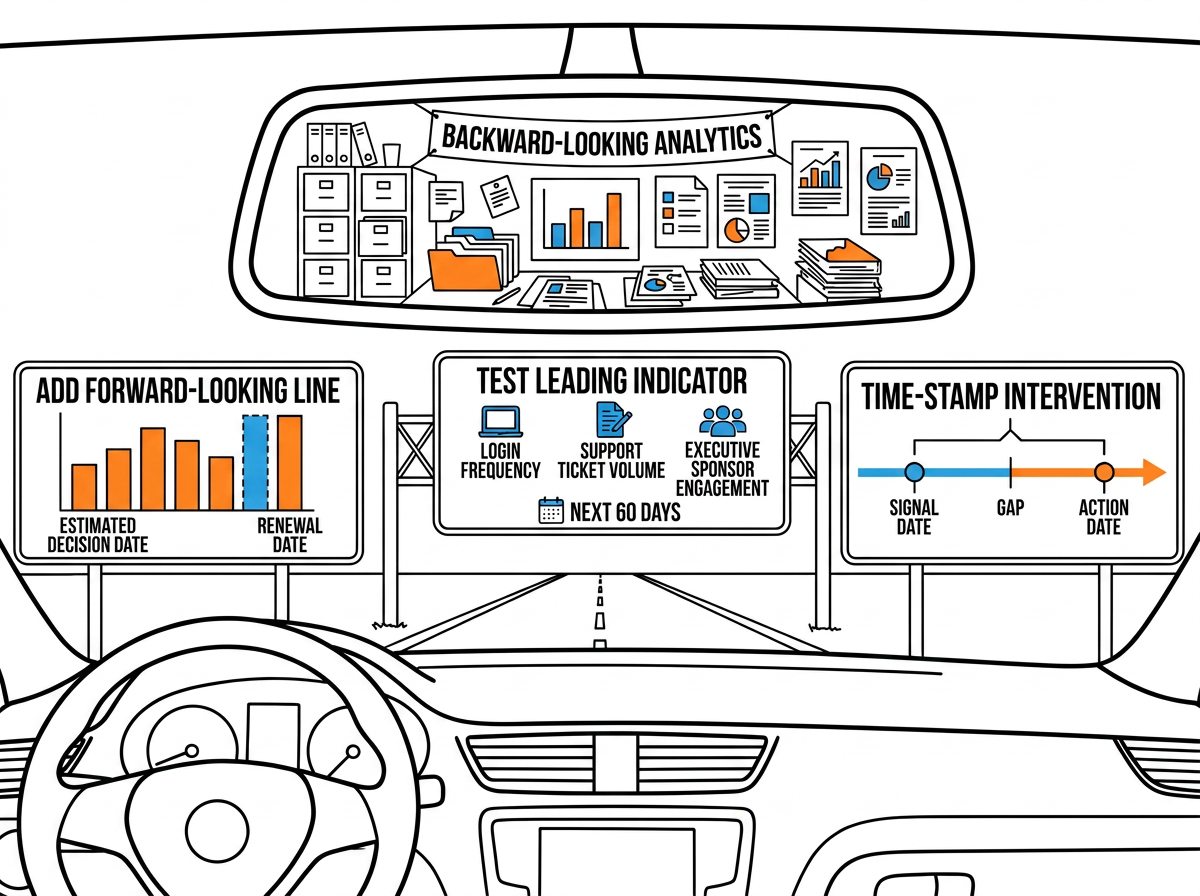
W. Edwards Deming called this "management by results" and compared it to driving a car by looking in the rear-view mirror. The cost of looking backwards is not measured in dashboard subscriptions. It is measured in every customer decision you learn about after it has already been made.
[Read the full article: "The Cost of Looking Backwards" → Here].
The Practitioner's Take
The Quarterly Photograph - Maurice FitzGerald
At HP, I participated in the regular Executive Committee CX reviews for years. The slides were thorough. The trends were clear. The verbatims were carefully chosen. And every number in the deck described something that had already happened.
I remember a colleague presenting a sharp NPS decline in one business segment and recommending immediate action. The leadership team agreed. A task force was formed. By the time it held its first meeting, three weeks later, two of the accounts driving the decline had already made their (non-) renewal decisions. We were not late by days. We were late by months. The decisions had been made long before the survey captured them.
As I wrote in the last issue, the customers who left were the silent Passives. They did not complain. They did not escalate. They simply stopped engaging, and our backward-looking analytics had no way to surface that trajectory until after it had played out. We were producing a quarterly photograph of a customer base that was moving every day.
So therefore: ask yourself one question about your next CX review. Is there a single item on the agenda that describes something that has not yet happened? If every line is retrospective, the review is an autopsy, not a diagnosis. The shift to forward-looking intelligence starts with changing what the meeting is for.
The Field Tactic
Three Ways to Stop Managing by Rear-View Mirror
Three things to do this week if you suspect your survey data is telling you a story that is not a true representation of what will happen in the near future:
- Add one forward-looking line to your next executive review. Take your most recent churn data and, for each lost account, estimate how many months before the renewal the decision was effectively made. Present that gap alongside the retrospective numbers. The contrast tends to change the conversation.
- Test a simple leading indicator. Pick one behavioral signal you already have access to: login frequency, support ticket volume, executive sponsor engagement. Track it for your top fifty accounts over the next sixty days. You do not need a predictive model to start noticing trajectories. You need to start looking at data that describes what is happening now, not what happened last quarter.
- Time-stamp one intervention. The next time your team identifies a risk, record the date. Then record the date action was taken. Measure the gap, and make it visible. Most organizations discover that weeks or months pass between signal and response, not because people are negligent, but because the workflow was designed around periodic reviews rather than continuous intelligence.
The Data Point
The number:
40%
That is the improvement in predictive accuracy when organizations shift from lagging indicators and subjective input to signal-based intelligence, according to Forrester. Technology sector studies show the gap in practice: machine-learning-based forecasting achieves 88 percent accuracy compared to 64 percent for traditional human judgment.
24 percentage points is not a marginal improvement. It is the difference between a system that gets the call right on nearly nine out of ten accounts and one that is wrong more than a third of the time. That gap is the cost of looking backwards, expressed as a number.
Source: Forrester Research
The Iconoclast Question
This rear-view mirror test
In your last quarterly internal customer experience review, how many of the items on the agenda described something that had not yet happened? If the answer is zero, every decision that came out of that meeting was a response to the past. Is that what your leadership team thinks it is paying for? Hit reply to let other readers know too.
The Field Bridge
The Customer AI Masterclass shows what forward-looking customer intelligence looks like in practice. Module 4 covers insights and analytics.
[ Get Instant Access → Click here]
Coming in future editions
- The Tyranny of the Org Chart.
- Iceberg Dead Ahead? Customer Portfolio Management is Not a Game.
- Prevention Economics.
- Bad Survey Data or Pure Guesswork? A Better Solution to Both.
- Why NPS was never enough, and what replaces it.
- The Executive Sponsorship issue
Field Notes publishes every Tuesday. Each edition focuses on one topic — a trap, a framework, a field observation, or a pattern worth examining. If something in here resonates, or if you're seeing something different in your own programs, we'd like to hear about it.
- Richard Owen & Maurice FitzGerald

Responses