By Richard Owen & Maurice FitzGerald
Field Notes on Customer AI · Edition 015 · August 11th, 2026
Each Tuesday, Field Notes on Customer AI surfaces what we're seeing in the field: patterns from implementations, ideas worth stress-testing, and the occasional inconvenient truth about how Customer AI programs succeed or stall. No abstractions. No product pitches. Just the working knowledge that tends to matter.
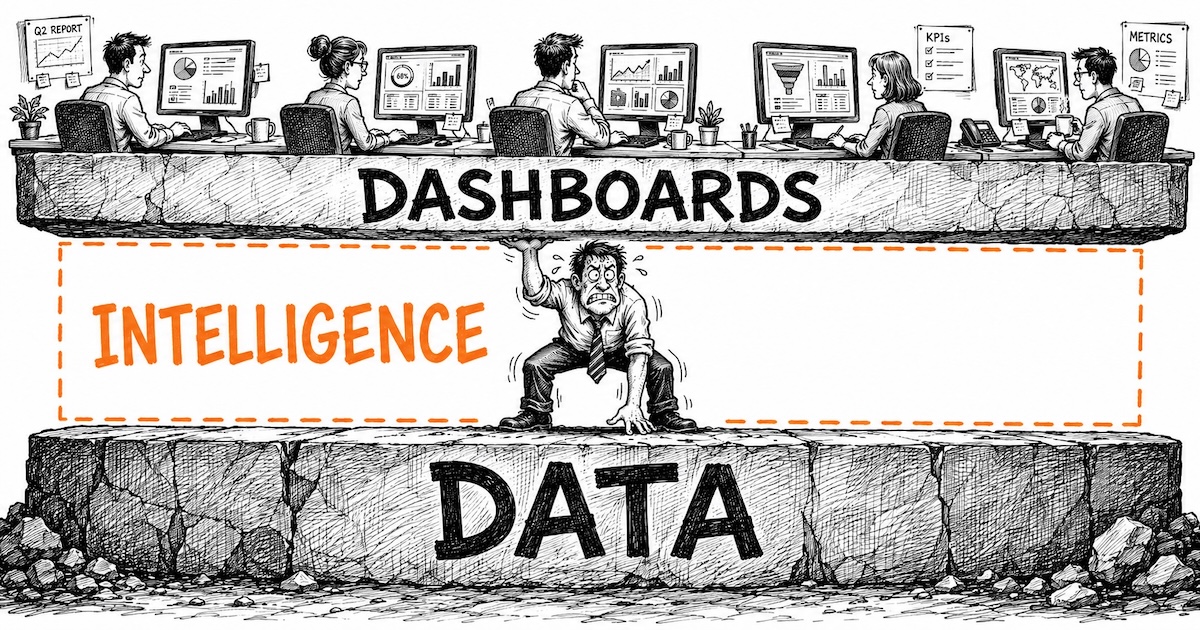
This time we are going to talk about the gap between the dashboards all companies use to manage their businesses and the data that these dashboards rely upon. Until recently, we depended entirely on human analytsts to apply data management methodologies and to decide what mattered most. That's changing now.
If you like what you read, please forward this to your colleagues and friends suggesting they learn more about customer retention and growth by subscribing here.
The Field Read
The Intelligence Gap the Market is Pricing - Richard Owen
The stock market has put a value on the separation we are now observing between what are known as Systems of Engagement and Systems of Intelligence. The resulting company valuation decisions are broadly correct, and it's worth understanding why.
Systems of Engagement hold data and provide the dashboards through which teams act on it. Both layers work. What has always been somewhat problematic is the layer between: intelligence, the ability to reason across the data and produce outputs a repository cannot produce on its own. That layer was supplied by humans. The analyst reading four dashboards and arriving at a judgment call was the intelligence layer. The system held the data. The human between the two provided the reasoning. What the market is now pricing is a technology layer that performs the reasoning a human was always asked to perform.
Every major customer engagement system vendor has noticed. Salesforce, Qualtrics, Medallia, Gainsight: each has spent a couple of years building an AI capability and describing it, in investor materials, as the beginning of a genuine intelligence business. The market's scepticism has nothing to do with the effort. It concerns the architecture underneath. These platforms are priced per seat, built around proprietary data stores, organised around a single function's workflow, and culturally constructed to sell engagement. A true intelligence layer reasons across data sets that were never designed to talk to each other, prices on outcomes rather than headcount, and serves the organisation rather than one department. You could think of it as asking a company to dismantle the economics that made it successful in order to become something its architecture was never designed to be. In financial services, where the customer relationship spans lending, wealth, insurance, and compliance, the single-function ceiling is particularly visible.
Foundation models will not solve this. They are infrastructure, not the application layer. AWS did not replace Salesforce. What they will do is make domain intelligence cheaper to build, which is what commoditising infrastructure does.
Read the full article: "The Intelligence Gap the Market is Pricing" →
The Practitioner's Take
The analyst who was the intelligence layer – by Maurice FitzGerald
I worked for years in a software business world where large enterprise customers generated data across four systems. The CRM held the sales relationship. The support platform held the case history. The billing system held the revenue. Product telemetry held the usage patterns. None of these systems could talk to each other in any meaningful way.
What we had instead was a senior analyst who had been with the team long enough to which which patterns in the support data predicted a possible renewal risk the CRM would not surface for another quarter. She read four dashboards every morning and arrived at judgments no individual system could produce. When the analyst left the company, we discovered something uncomfortable. The intelligence had not been in the systems. It had been in her. The data was still there. The reasoning was gone.
I spent months trying to document what she knew, and I failed. Most of it could not be documented because it was not a process (or at least, that's my excuse). It was pattern recognition across systems that had never been designed to connect.
So therefore: ask yourself who performs the reasoning layer in your customer operation. If the answer is a person, you have a system of engagement with a human filling the gap. That works until the human leaves.
The Field Tactic
Three questions to test whether your customer-touching systems have intelligence, or just build reports
1. Check the pricing model. If your vendor charges per seat, the value proposition is more people using the workflow. An intelligence layer prices on what it produces, not how many people log in. Ask your vendor what outcome-based pricing would look like. The response tells you whether you are buying engagement or intelligence.
2. Count the data sources. If your platform reasons only across data it collected itself; survey responses, CRM records, or tickets, you have the best possible silo of one data category. In financial services, for example, true intelligence means reasoning across lending, claims, compliance, and service data in a single layer, not four dashboards.
3. Ask who the intelligence layer is. If the answer is an analyst reading dashboards and making judgment calls, you have identified both the value and the vulnerability. That person's pattern recognition is the intelligence your system does not have.
The Data Point
The adoption gap
The number: 20/50% versus less than 1%
That is the distance between what AI delivers at the task level and what it produces in aggregate productivity, according to the Bank for International Settlements 2026 Annual Economic Report. Individual tasks show time savings of twenty to fifty percent. Aggregate productivity growth remains below one percent over the long horizon. The gap is not a sign that AI does not work. It is a sign that most organisations have not built the domain intelligence, workflow redesign, and data integration that converts task-level capability into enterprise-level results. The gap is the intelligence layer, missing.
Source: Bank for International Settlements, Annual Economic Report 2026; cited in Richard Owen, "The Intelligence Gap the Market is Pricing" (See link above).
The Iconoclast Question
The reasoning layer
Your CX platform holds the data. Your dashboards display it. Who in your organisation performs the reasoning that connects what customers said to what they will do next? If that reasoning depends on a person rather than a system, what happens when the person is not available?
The Field Bridge
The Customer AI Masterclass is the certification program Richard built for CX, CS, and RevOps leaders who need to move from survey-dependent reporting to predictive account intelligence. Eight units. Self-paced. Built for practitioners, not data scientists.
[ Explore the Customer AI Masterclass →]

If you've been reading Field Notes, you know the problem isn't awareness - it's execution. Knowing that AI can improve retention or accelerate revenue doesn't tell you how to make it happen in your organisation. That's exactly the gap The Customer AI Field Guide was written to close. Authored by Richard Owen and Maurice FitzGerald (that's us), it's a practical execution guide for CX, CS, and RevOps leaders, covering how to identify at-risk accounts before they signal churn, convert customer insights into frontline action, build the financial case that gets CFO sign-off, and design Customer AI systems your teams will actually adopt. Theory optional. Results required.
[ Get the Customer AI Field Guide → Now on Amazon]
Field Notes publishes every Tuesday. Each edition focuses on one topic - a trap, a framework, a field observation, or a pattern worth examining. If something in here resonates, or if you're seeing something different in your own programs, we'd like to hear about it.

Responses