NO. 028 · NOVEMBER 10, 2026
This week is about the asset that rarely appears in the plan: the customer. Private equity's software playbook leaves it out, and the arrival of AI agents is about to test who actually owns it.
🟣 THIS WEEK IN THE FIELD
A Seven-Year Hold and an Eight-Year Customer
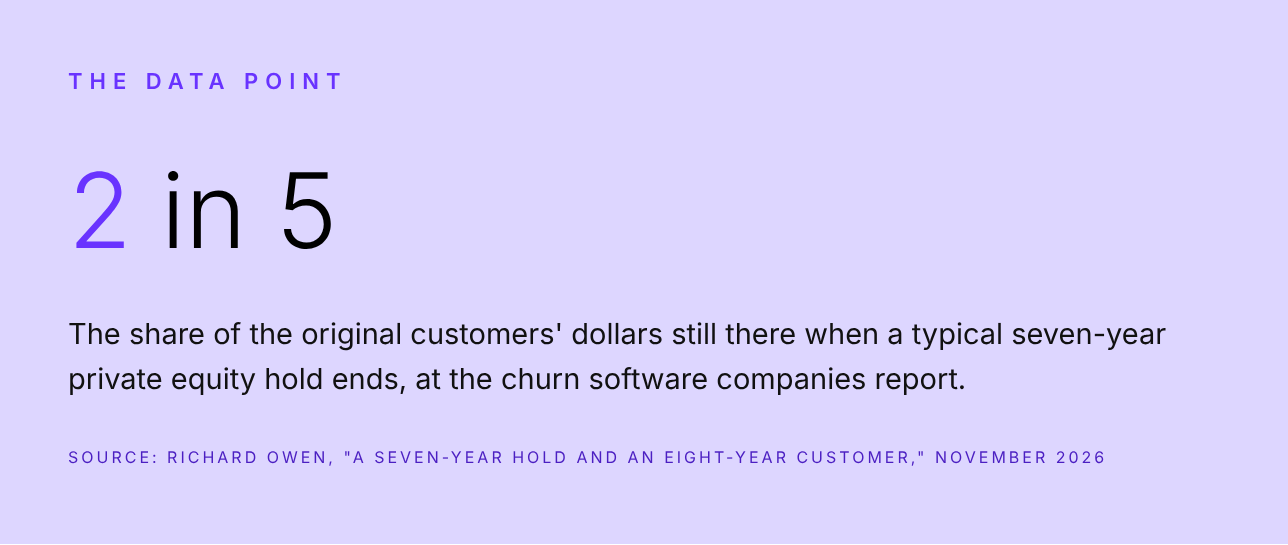
The average software customer stays about eight years. The average private equity owner now holds for seven. By exit, only about two in five of the original customers' dollars are still there, and every dollar replaced costs about two in sales and marketing. Bain says buyouts now need 10 to 12 percent annual EBITDA growth. The one lever left with headroom is the customer base the owner already bought.
The Last Buyer in the Room
Salesforce spent more than $10 billion this year on customer experience assets, from Fin and Momentum to Listen Labs, Loops and Braze. Every one of them learns from customers who interact. None of them sees the customer who has gone quiet, and that is the customer about to leave. Several deals have not closed, so treat "integrated customer intelligence" as roadmap until a product and a named customer appear together.
🟣 THE BREAKDOWN
Both articles describe a buyer who owns the customer relationship on paper and cannot answer the obvious question about it. A sponsor buys a revenue line at a multiple and is paid on EBITDA at exit. Salesforce buys a research firm, an analytics firm, a service agent and a messaging platform. Neither purchase comes with a view of which accounts will still be there next year.
The reason is the same in both cases. Every tool in the chain learns from customers who do something: call support, attend a meeting, answer a survey. The customer who stops doing all of those disappears from view, and silence is predictive. Meanwhile, a health score designed by the people who need it to be green will be green.
Inside an enterprise account base, the fix starts with a baseline: an independent view of every account, including the ones nobody calls. It asks three questions. Is the account at risk? Is it underpenetrated? What is driving each answer? The third is the only one you can act on.
Seeing this in your own account base? Reply to this email.
🟣 THE FIELD TACTIC
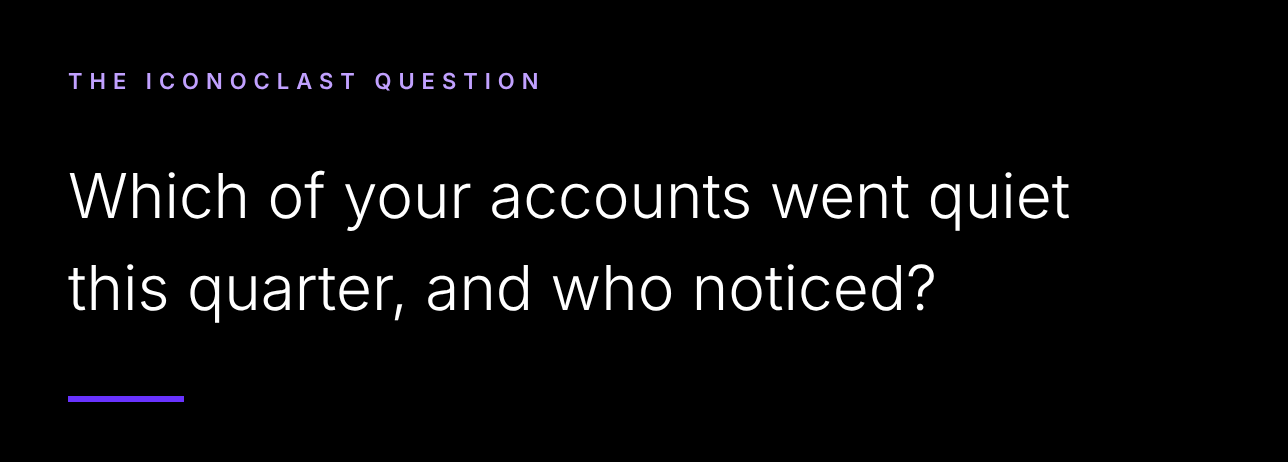
Three ways to find the customers who are about to leave
- Build a baseline you did not design. Form an independent view of the health of every account, not the one in management's dashboards. If it comes out better than expected, you have found margin of safety; if worse, you found out early.
- Count the customers who are not talking. List the accounts that have stopped calling support, attending meetings or answering surveys. Those are the ones your current tools cannot see.
- Make your NPS program a decision, not a default. If it runs on GetFeedback Direct, that tool stops on December 31. Decide what you measure before the migration decides it for you.
🟣 FOR ENTERPRISE TEAMS
OCX Cognition's Customer AI Analyst reads every account in your base from what customers do as well as what they say, so an efficiency program can be judged on what happens to the customers, not just the tool. It shows which accounts are at risk, and why, before they decide to leave. If you'd like to see it on your own data, we'll walk you through it.
🟣 GO DEEPER
The Customer AI Field Guide is a practical guide for CX, CS and RevOps leaders on turning customer intelligence into revenue action.
The Customer AI Masterclass is a self-paced certification, 8 modules over about 8 hours, where you earn both NPS® Certification and Customer AI Certification. Learn more.
Learn more about certification →
Until next week,
Richard Owen
Co-founder and CEO, OCX Cognition
Joined and then led the team that co-created NPS.
Know someone who should read this? Forward it, or they can subscribe here
Responses