NO. 027 · NOVEMBER 3, 2026
This week is about the asset that rarely appears in the plan: the customer. Private equity's software playbook leaves it out, and the arrival of AI agents is about to test who actually owns it.
🟣 THIS WEEK IN THE FIELD
Private Equity's Software Playbook Has Three Pages and No Customer
Private equity's software playbook comes down to three moves: buy more companies, run them cheaper, and bet that the market has priced them wrong. Every one of those levers works on the balance sheet. None of them touches the customer. That omission used to be cheap to carry. It is no longer affordable, and the reasons are worth understanding before your next value creation plan is written.
The Warehouse Without a Shopfront
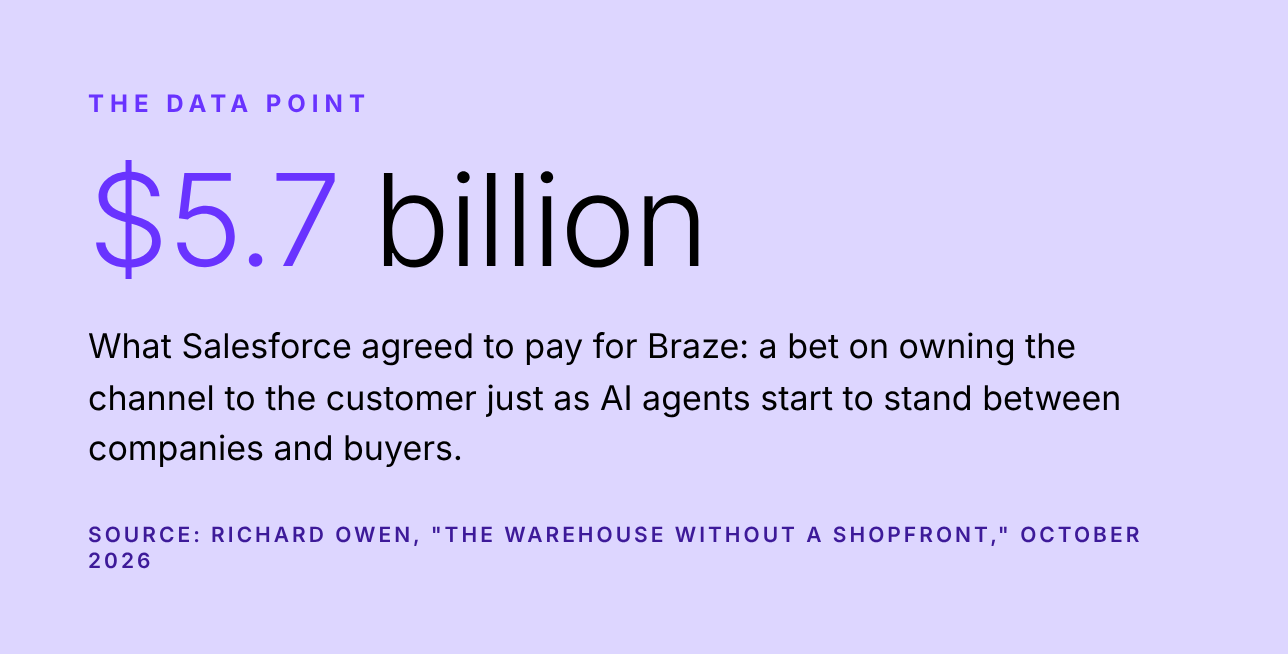
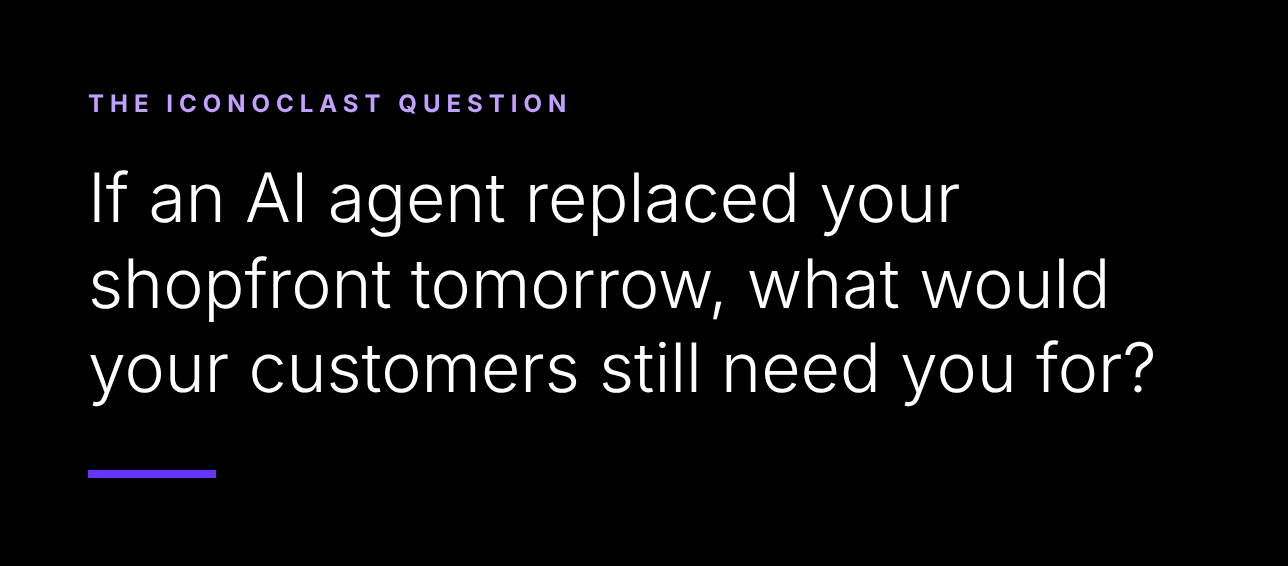
Salesforce has agreed to pay about $5.7 billion for Braze. The deal points to a harder question for every company that sells through software: when an AI agent becomes the interface to your business, the shopfront belongs to someone else, and what you have left is the warehouse. The test is whether anything in it, starting with what you know about your customers, is something the agent cannot get elsewhere.
MORE THIS WEEK
The Metric I Helped Build, Audited
Other Than That, Mrs. Lincoln: A Survey Vendor Explains the Future
🟣 THE BREAKDOWN
Both featured pieces ask the same question from opposite ends. The private equity playbook values a software company on what can be bought, cut and re-rated. The agent economy values it on what an AI cannot source somewhere else. In neither model does the customer relationship appear as a line, and in both it is the thing that decides the outcome.
The common failure is treating the customer as a consequence of the plan rather than an input to it. A cost program assumes customers will stay. A platform strategy assumes they will keep coming through the front door. Once an agent sits between you and the buyer, neither assumption survives without evidence, and most organizations have not collected any.
Inside an enterprise account base, the asset worth owning is knowledge nobody else has: which accounts are expanding, which are drifting, and why. That knowledge is built from what customers do, not from a two-question survey, and it is the one thing in the warehouse an agent cannot stock for itself.
Seeing this in your own account base? Reply to this email.
🟣 THE FIELD TACTIC
Three ways to put the customer back into the plan
- Write the customer into the value creation plan. For every lever, whether cost, acquisition or pricing, name the accounts it touches and the behavior you expect from them. If nobody can answer, the lever has not been tested.
- List what you know that an agent cannot. Inventory the customer data that exists only inside your business: usage, support history, renewal behavior. If the list is short, so is your defensible position.
- Audit your beacon metric. Establish which claim about your main customer number has actually been tested inside your business, at what level, against which financial outcome. Most organizations find the honest answer is none.
🟣 FOR ENTERPRISE TEAMS
OCX Cognition's Customer AI Analyst reads every account in your base from what customers do as well as what they say, so an efficiency program can be judged on what happens to the customers, not just the tool. It shows which accounts are at risk, and why, before they decide to leave. If you'd like to see it on your own data, we'll walk you through it.
🟣 GO DEEPER
The Customer AI Field Guide is a practical guide for CX, CS and RevOps leaders on turning customer intelligence into revenue action.
The Customer AI Masterclass is a self-paced certification, 8 modules over about 8 hours, where you earn both NPS® Certification and Customer AI Certification. Learn more.
Learn more about certification →
Until next week,
Richard Owen
Co-founder and CEO, OCX Cognition
Joined and then led the team that co-created NPS.
Know someone who should read this? Forward it, or they can subscribe here

Responses