By Richard Owen & Maurice FitzGerald
Field Notes on Customer AI · Edition 006 · June 2, 2026
Each Tuesday, Field Notes surfaces what we're seeing in the field: patterns from implementations, ideas worth stress-testing, and the occasional inconvenient truth about how Customer AI programs succeed or stall. No abstractions. No product pitches. Just the working knowledge that tends to matter.
This edition covers a topic that most CX and Customer Success teams think they address, but don't: The best time to fix it is before it breaks.
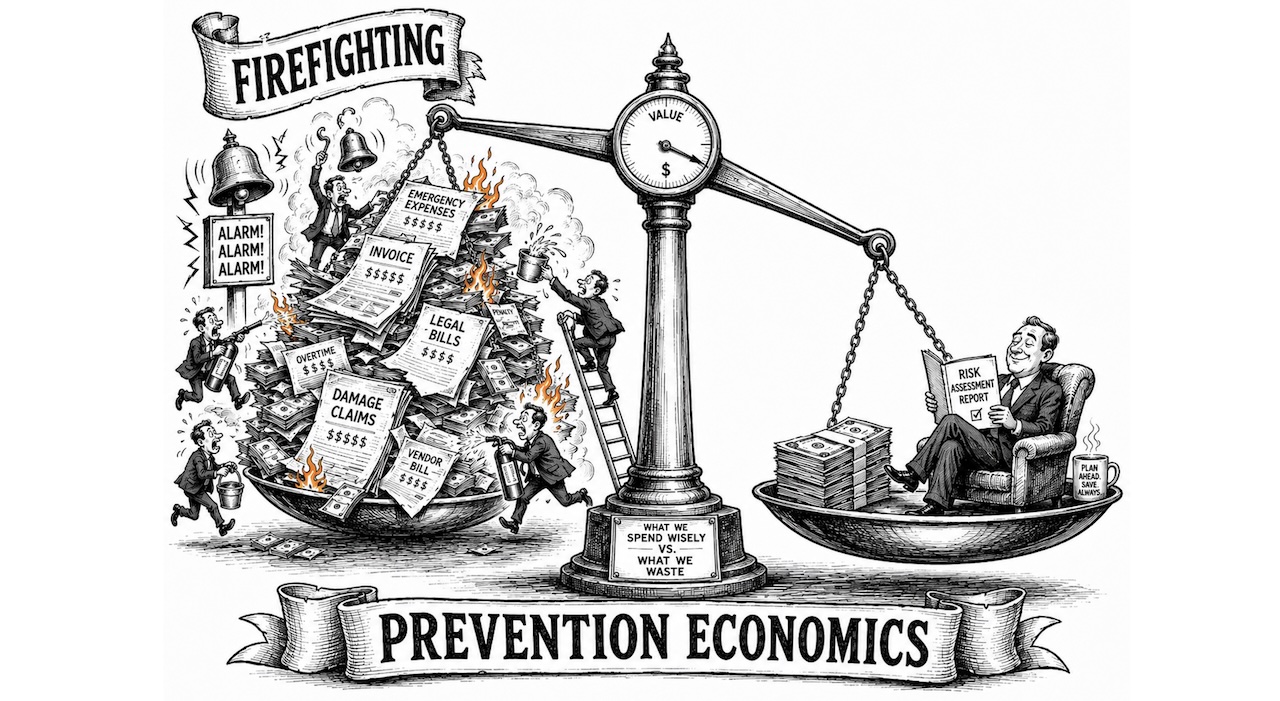
(Created using DALL/E)
The Field Read
Prevention Economics - Richard Owen
An ancient Chinese medical text, the Huangdi Neijing, classified physicians into three grades: the superior doctor prevents sickness, the mediocre doctor attends to impending sickness, the inferior doctor treats actual sickness. That was written roughly twenty-four centuries ago. We are still working on it.
Most companies today operate a customer management model that is, in its essential structure, an emergency medicine system. Customer success teams are staffed, trained, and incentivized to respond to problems. An account shows signs of distress and resources are deployed to stabilize the situation. Save teams exist precisely for this purpose: senior people, authorized to make concessions, deployed when a relationship is on the verge of collapse. Nobody asks why the patient ended up in the emergency room in the first place.
The economics of this model are poor. Early in a deterioration, the intervention required is often modest: a strategic conversation, a realignment of expectations, a proactive check-in from someone senior enough to signal that the relationship matters. These are low-cost, high-probability actions. Wait six months and the economics invert. The customer has started evaluating alternatives. Internal champions have gone quiet. Now you are negotiating a rescue, and the probability of success is dramatically lower. You can run multiple successful early interventions for the cost of a single late-stage rescue, with better outcomes in both cases.
If the economics are this clear, why does the firefighting model persist? Three reasons. First, you cannot prevent what you cannot predict, and until recently the predictive tools did not exist. Second, the firefighting model creates visible heroes, while prevention creates invisible ones. The executive who saves a million-dollar account gets recognized. The analyst whose early warning prevented twenty accounts from reaching crisis is invisible, because the crises never happened. Third, the entire organizational infrastructure is built around response: escalation paths, war rooms, save playbooks, and a Slack channel with more traffic than any channel devoted to proactive account development.
Nassim Taleb made the point that it is far easier to identify fragility than to predict the specific event that exploits it. Prevention does not require omniscience. It requires the ability to see which accounts are fragile before the event arrives.
[Read the full article: "Prevention Economics" → Here]
The Practitioner's Take
Who gets the credit for saving the customer? - Maurice FitzGerald
As Richard's article suggests, the relative perceptions and rewards for 'running to the fire' and saving customers are usually the opposite of what they should be, in a totally rational B2B world. In the real world, a senior team will fly in, negotiate concessions, rebuild the relationship over weeks, and bring it back from the edge. When it workes, the 'save team' is celebrated. The executive who led the rescue gets visible credit. And usually, nobody asks how the account went on fire in the first place.
And nobody measures the cost. The senior people's time. The concessions. The weeks of planned work that got shelved while every experienced person was in a war room working on the one account that had already caught fire. And the cost of other accounts that quietly deteriorated during the rescue, because the people who might have noticed the early signals were busy saving the one that was loudest.
So therefore: count how many of your team's hours last quarter went to accounts already in crisis versus accounts showing early signs of drift. If the ratio is heavily skewed toward crisis, your operating model is an emergency room. The economics will not change until the measurement does.
The Field Tactic
Three steps from firefighting to prevention:
- Measure your firefighting ratio. Track how your Customer Success and CX teams' time splits between reactive crisis work and proactive outreach over the next thirty days. Most organizations discover the ratio is 80-20 or worse in favor of firefighting. Making it visible is the first step to changing it.
- Build one early-warning trigger. Pick a single leading indicator: declining login frequency, a missed QBR, a drop in executive sponsor engagement. Set a threshold that fires a notification at least 90 days before renewal. You do not need a full predictive model to start. You need one signal and one response protocol.
- Make one prevention story visible. The next time an early intervention stabilizes an account, write up the case: what the signal was, when you acted, what would have happened if you had waited. Present it alongside the next dramatic save. Prevention needs its own narrative to compete with heroism.
The Data Point
The number - the 25% profit lever:
25%
That is the minimum increase in profit produced by a five percent improvement in customer retention, according to research by Bain & Company. In some industries the figure exceeds one hundred percent. The arithmetic is straightforward: retained customers cost less to serve, buy more over time, refer others, and are less price-sensitive.
A five percent improvement in retention is not achieved through better late-stage rescues. It is achieved through the systematic early intervention that prevents accounts from reaching the rescue stage in the first place. Prevention economics is not a theory. It is the mechanism behind the most widely cited profitability finding in customer management.
Source: Bain & Company (Reichheld)
The Iconoclast Question
The Invisible Hero Problem
The Field Bridge
The Customer AI Masterclass covers how to build an intervention model around early signals instead of late-stage rescue. Module 5 is where it starts.
[ Get Instant Access → Click here]
Coming in Future Editions
- Bad Survey Data or Pure Guesswork? A Better Solution to Both.
- The Survey Platform Reckoning.
- Why Culture Eats Customer AI for Breakfast.
- Enterprise AI Is Failing the Same Way Enterprise IT Always Did.
- Why NPS was never enough, and what replaces it.
- The Executive Sponsorship issue.

If you've been reading Field Notes, you know the problem isn't awareness - it's execution. Knowing that AI can improve retention or accelerate revenue doesn't tell you how to make it happen in your organisation. That's exactly the gap The Customer AI Field Guide was written to close. Authored by Richard Owen and Maurice FitzGerald (that's us), it's a practical execution guide for CX, CS, and RevOps leaders, covering how to identify at-risk accounts before they signal churn, convert customer insights into frontline action, build the financial case that gets CFO sign-off, and design Customer AI systems your teams will actually adopt. Theory optional. Results required.
[ Get the Customer AI Field Guide → Now on Amazon]
Field Notes publishes every Tuesday. Each edition focuses on one topic - a trap, a framework, a field observation, or a pattern worth examining. If something in here resonates, or if you're seeing something different in your own programs, we'd like to hear about it.

Responses